Industrial Lubrication Pumps and Coolers: Duty-Matching Guide
Lubrication duty, not catalogue size, decides which pump and cooler a smart manufacturing line needs. A line that places a reducer, a hydraulic power unit and an extruder within a few metres of each other asks three separate questions of its oil circuit: how much oil must reach the friction points per minute, whether the flow has to reverse, and how much heat must leave the oil before viscosity drifts out of range. This guide maps those questions to four DEO units — the DK630 electric lubrication pump, the PST180 bidirectional internal gear pump, the PSN100 trochoidal pump and the DFLSL-10 self-circulating cooler — and shows where the DWBW-408-T fin-type oil/water cooler or the DFLEX8 wind cooler is the better fit.
It is written for the project stage where equipment selection is still open: engineering teams and procurement staff comparing configurations before an RFQ, and buyers who already have a duty description but have not decided whether that duty belongs to an electric lubrication pump, a mechanical gear pump, or a cooler with its own circulation loop.
Why the duty profile decides the pump, not the other way round
Four variables set the starting point of any lubrication pump selection: the viscosity of the oil being moved, the flow needed per minute, the pressure required at the furthest lubrication point, and the heat the circuit has to shed. A pump that satisfies three of these and misses one will show the failure at the fourth point — usually as insufficient suction, oil overheating, or seal and bushing wear.
The direction of automation matters here. An attributed 2024 commercial market study (Custom Market Insights) estimates that 67% of newly commissioned industrial machines were equipped with automatic lubrication systems, which means the pump is increasingly inside the machine's control scope rather than a stand-alone manual task. That shift does not change the physics, but it does change how the pump is specified: flow, pressure, temperature limits and cooler capacity have to be documented before the line is commissioned, because there is no operator walking the line with a grease gun to compensate for a marginal choice.
In practice, buyers who start from a duty description reach a defensible configuration faster than buyers who start from a pump model. The sections below therefore work from duty to unit, and the checks at the end apply to every combination.
The four duty roles a smart line imposes
A smart manufacturing line typically contains all four of the following roles, and each one pulls selection in a different direction.
- Continuous delivery to friction points. Oil is pushed to gears, bearings, slideways and chains at low pressure but steady flow, often around the clock. Viscosity tolerance and suction reliability matter more than peak pressure.
- Hydraulic power and bidirectional transfer. Oil is used to transmit force, or must be moved in either direction as a circuit reverses. Displacement per revolution and the pump's ability to run in both directions become the deciding parameters.
- Independent conveying. A smaller, separate loop — a cooling circuit, a transfer line, an external drive — needs its own pump without being tied to the main hydraulic circuit.
- Heat rejection. The oil that carries heat away from the friction points has to give that heat up somewhere: to plant water, to air, or to a dedicated closed loop with its own circulating pump and fan.
Attempting to serve all four roles with one pump usually produces an oversized main pump and an undersized cooler. Splitting them produces a configuration where each unit operates near its documented range.
Duty role 1 — continuous lubrication of gears, bearings and slides: DK630
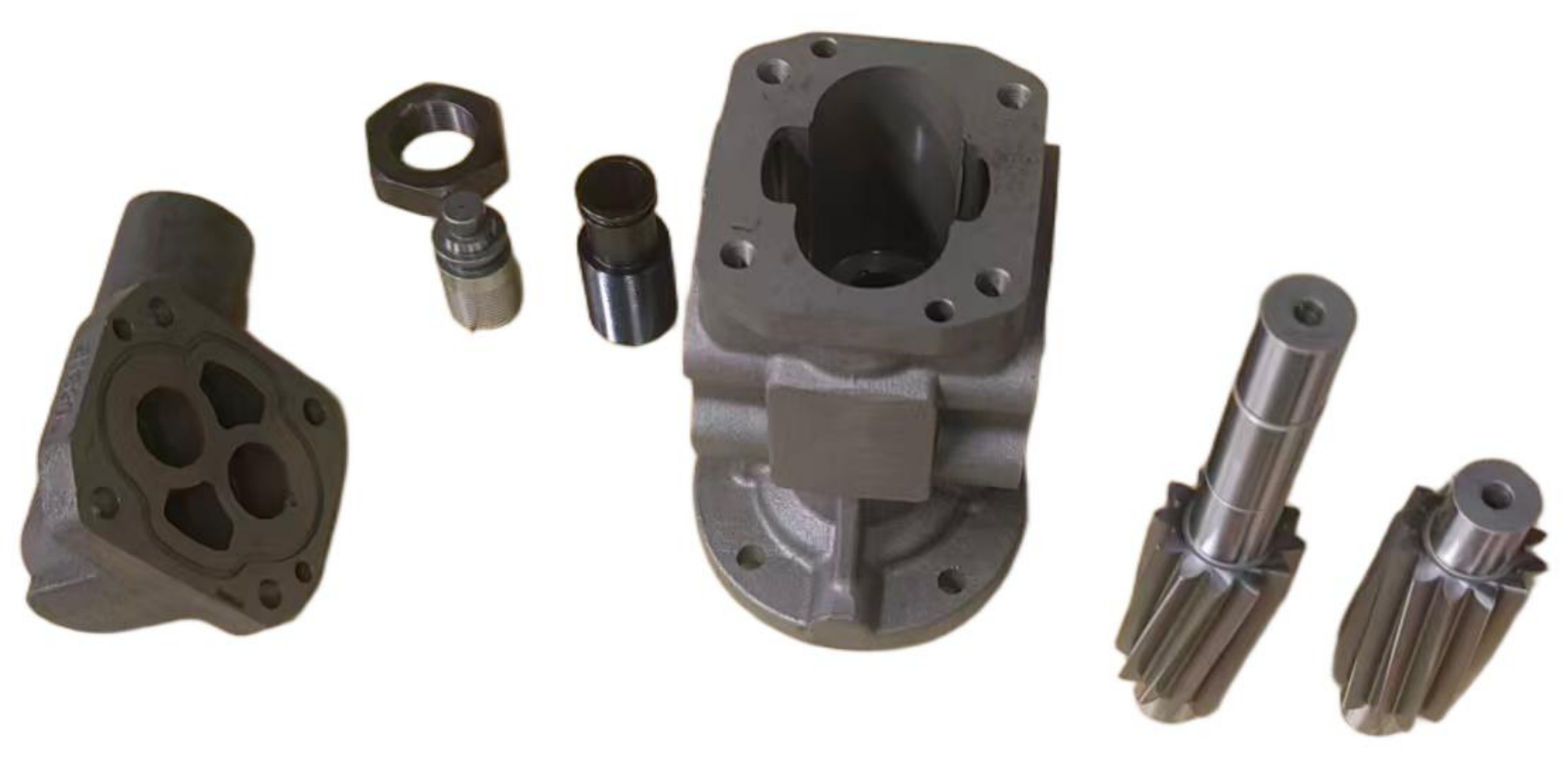
The DK630 is a DEO electric lubrication pump with a displacement of 630 cc/rev, a motor speed of 950 rpm or 1450 rpm, and a QT500 body. DEO lists it for machinery and heavy industry, and the model's declared application keywords include lubrication pumps for mining equipment, construction machinery and the steel industry — three duties that share the same characteristic: long running hours, high-viscosity oil, and a lubrication point that cannot be allowed to run dry.
The wider DK series it belongs to adds the parameters that matter at the specification stage. DEO documents the DK series as a low-noise helical external gear positive displacement pump, available as a standard DK model for general industry and a DKF version for wind power, with a complete MDK unit (pump, motor and bell housing coupling) available when a single integrated drive assembly is preferred. Documented limits for the series are a kinematic viscosity range of 12–20000 cSt, a fluid temperature range of −40 °C to +100 °C, and a built-in relief valve with a standard setting of 5–25 bar. The series is documented for 24/6 operation.
What the DK630 numbers mean in practice
Displacement alone tells a buyer very little, because flow is displacement multiplied by speed. On that arithmetic, 630 cc/rev at 950 rpm corresponds to approximately 599 L/min of geometric displacement, and at 1450 rpm to approximately 914 L/min. Those are calculated figures, not measured delivery: slip, viscosity and inlet conditions reduce real flow, and the calculation is useful mainly for confirming that the pump's displacement class matches the circuit being fed, and for framing the conversation with the pump supplier.
Two consequences follow for the project. First, a pump of this displacement class is normally feeding a substantial circuit — a large reducer, a mill stand lubrication station, a central oil reservoir serving several machines — rather than a single bearing housing. Second, the inlet side becomes the limiting element: moving several hundred litres per minute through an undersized or leaking suction line produces cavitation long before the pump reaches its pressure limit, which is why the installation checks later in this guide carry as much weight as the model number.
Where the DK630 fits, and what to check before committing
The DK630 fits continuous-duty circuits with clean lubricating or hydraulic oil of good lubricity, where the oil temperature stays inside −40 °C to +100 °C and the relief valve setting of 5–25 bar covers the circuit's protection requirement. It is the natural choice for steel-industry lubrication stations, mining reducers and construction machinery where the oil is viscous and the duty is unbroken.
It is a less obvious choice where the circuit must reverse. The DK series documentation is explicit that the marked rotation direction on the pump nameplate must be followed, and that reverse rotation invalidates sealing and causes leakage failure. Where flow direction changes are part of normal operation, the bidirectional units described next are the correct starting point rather than a DK pump with a reversing motor.
Three limits from the same documentation belong in the specification review: the pump must not be run dry, because dry friction damages shaft bushings and gears quickly; oil above roughly 1000 cSt requires reduced pump speed to avoid excessive suction resistance; and the built-in relief valve is for transient pressure protection only, since continuous overflow operation leads to overheating and early wear. A circuit that relieves continuously needs a system-level fix, not a larger valve.
Duty role 2 — bidirectional flow and hydraulic power units: PST180
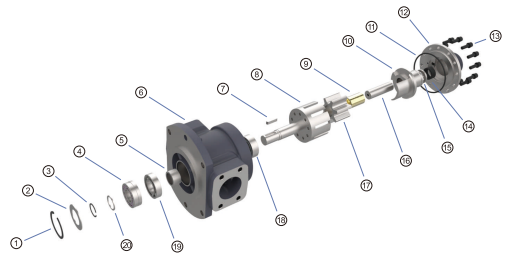
The PST180 is a DEO bidirectional internal gear pump with a displacement of 180 cc/rev, a maximum speed of 1800 rpm and an operating temperature range of −30 °C to +100 °C. The housing is available in GG250 grey cast iron or QT500 ductile iron. DEO lists it for hydraulic systems, construction machinery, engine lubrication systems, automation mechanical equipment, forklifts and telehandlers, hydraulic power units and industrial cooling systems.
The defining characteristic is direction. A bidirectional internal gear pump can be driven in either rotation direction, which suits circuits that reverse, machines whose drive direction is set at installation rather than fixed by design, and hydraulic power units where the same pump serves as the pressure source in both operating states. On the arithmetic used earlier, 180 cc/rev at 1800 rpm corresponds to approximately 324 L/min of geometric displacement — again a calculated figure rather than measured delivery, and one that should be compared against the actual flow requirement of the hydraulic power unit rather than used as a headline specification.
Bidirectional capability changes the surrounding design, not just the pump choice. Because suction and discharge swap when rotation reverses, filtration, reservoir return and any check-valve arrangement have to work in both directions. A circuit designed for one-direction flow and fitted with a bidirectional pump can starve the inlet on the reverse stroke, and the pump will be blamed for a system layout problem.
Duty role 3 — independent conveying and lower-flow circuits: PSN100
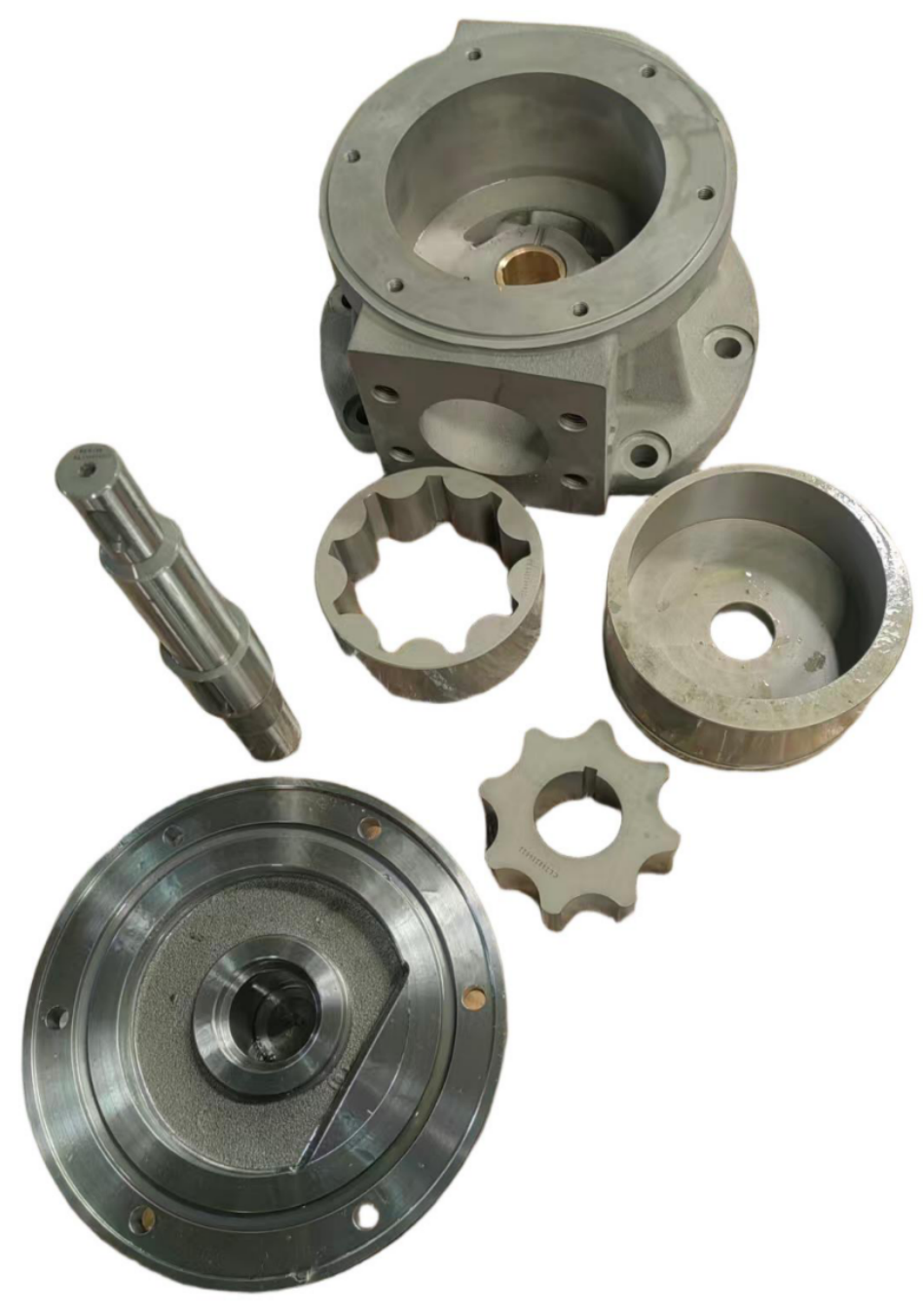
The PSN100 is a DEO trochoidal pump, also described as a bidirectional mechanical pump, with a displacement of 100 cc/rev, a maximum speed of 1800 rev/min, an operating range of −30 °C to +100 °C and a QT500 ductile iron body. DEO lists it for lubricating systems, cooling systems and external-drive independent conveying systems.
Its role on a smart line is usually the loop that should not be tied to the main hydraulic circuit: a separate cooling or transfer loop driven by its own motor, a smaller lubrication circuit where 100 cc/rev is already sufficient, or an independent conveying duty that has to keep running when the main machine is stopped. At the maximum 1800 rpm the geometric displacement works out to approximately 180 L/min, half that of the PST180 at the same speed.
Trochoidal geometry is a well-established positive-displacement principle in which an inner rotor with one fewer tooth drives an outer rotor, producing smooth, low-pulsation delivery in a compact housing. That characteristic is useful where the lubrication points are close together and pressure pulsation would show up as uneven oil distribution, but it does not by itself make the PSN100 a substitute for a high-displacement pump on a large circuit — the displacement range sets that boundary.
PST180 and PSN100 compared on the parameters buyers actually screen
Both units are bidirectional mechanical pumps documented for the same temperature range, so the decision between them is driven by displacement, material and intended duty rather than by a general quality difference. The table below uses only the parameters documented for each model.
| Parameter | PST180 | PSN100 |
|---|---|---|
| Pump type | Bidirectional internal gear pump | Trochoidal pump, bidirectional mechanical pump |
| Displacement | 180 cc/rev | 100 cc/rev |
| Maximum speed | 1800 rpm | 1800 rev/min |
| Temperature range | −30 °C to +100 °C | −30 °C to +100 °C |
| Body material | GG250 grey cast iron or QT500 ductile iron | QT500 ductile iron |
| DEO-listed applications | Hydraulic systems, construction machinery, engine lubrication, automation equipment, forklifts and telehandlers, hydraulic power units, industrial cooling systems | Lubricating systems, cooling systems, external-drive independent conveying systems |
| Geometric displacement at maximum speed (calculated) | approx. 324 L/min at 1800 rpm | approx. 180 L/min at 1800 rpm |
The calculated row is arithmetic — displacement multiplied by speed, converted from cc to litres — and is included to make the ratio between the two models visible, not to describe delivered flow. Real delivery depends on viscosity, inlet conditions and internal leakage, and should be confirmed against the duty point with the supplier.
Duty role 4 — heat rejection: DFLSL-10, DWBW-408-T or DFLEX8
Once the pump selection is settled, the cooling decision usually determines whether the pump's specification holds over a full shift. Heated oil loses viscosity, and lower viscosity increases internal leakage and reduces the oil film at the friction points — the pump then runs outside the conditions it was selected for. DEO's cooling range covers three different answers to that problem.
DFLSL-10 self-circulating cooler. A self-circulating cooler is an integrated unit combining radiator, circulating oil pump, fan, filter and control accessories into a closed loop that is separated from the host hydraulic circuit. DFLSL-10 is documented with a cooling capacity of 1.61/1.84 kW/℃, an oil pump flow (VG46) of 100–125 L/min or 150–200 L/min, and a consumed power of 5.5/7.5 kW. DEO lists it for hydraulic and lubricating systems, extruding machinery, forging and stamping equipment, shearing machines, gearboxes, large bearings, large reduction boxes and smelting equipment.
The separated loop is the point of the design: DEO's DFLS-series documentation describes an independent closed self-circulation circuit in which a built-in circulating pump draws hot oil from the host tank or lubrication loop, passes it through the radiator core and returns it cooled, so that pressure fluctuations in the main hydraulic circuit do not disturb cooling performance. The same documentation lists an optional temperature bypass valve with a 45–55 °C opening threshold, which lets cold oil bypass the radiator at start-up and reach operating temperature faster, plus optional pressure bypass and temperature/pressure switches for alarm monitoring.
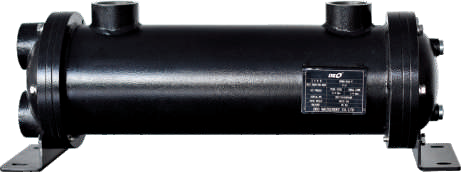
DWBW-408-T fin-type oil/water cooler. This is a shell-and-tube finned heat exchanger with a detachable end cover for internal cleaning. Documented ratings are 16 bar maximum working pressure on the oil side, 10 bar on the water side, oil medium temperature up to 120 °C, cooling water temperature of 5–60 °C and applicable oil viscosity of 12–320 mm²/s. Connection ports are G1 or G1-1/2 threaded flanges with SAE flanges optional, and the single-unit heat exchange area range runs from 1.3 m² to several tens of square metres. DEO lists rolling mill lubrication stations, hydraulic presses, forging equipment, mine reducer lubrication systems, heavy excavator hydraulic stations and centralized hydraulic oil cooling for machine tools among its applications.
DFLEX8 wind cooler. An air-cooled unit with a comparative cooling capacity of 1.15/0.91 kW/℃, a 630 mm fan and a 3φ380 V motor. DEO lists it for hydraulic systems, coal mines, crude oil mining, construction machinery, lubricating systems, gearboxes, reducers, wind energy and cooling duties. Its value is independence from plant water: where water is unavailable, expensive to route, or the machine moves between sites, an air cooler removes the water-side fouling and freezing questions entirely.
Reading a kW/℃ cooling figure
DEO states cooling capacity as a per-degree coefficient rather than a single kW value, and that format is more useful for selection than it first appears. The coefficient describes heat rejection per degree of temperature difference between the oil and the cooling medium. Multiply it by the design difference to get an indicative heat rejection: at a 30 °C difference, a 1.61 kW/℃ unit corresponds to roughly 48 kW and a 1.84 kW/℃ unit to roughly 55 kW. Those are calculated indications, not guaranteed duty points — actual performance depends on oil flow, viscosity, ambient temperature, air or water flow and surface fouling, and the figure should be confirmed against the specific duty with the supplier.
The coefficient also explains why the same cooler can be adequate on one line and inadequate on another: a hot plant with a 20 °C approach temperature rejects far less heat through the same radiator than a cool plant with a 40 °C approach.
Matching cooler type to plant conditions
| Cooler | Type | Documented basis | Choose it when |
|---|---|---|---|
| DFLSL-10 | Self-circulating cooler | 1.61/1.84 kW/℃; oil pump flow 100–125 or 150–200 L/min (VG46); 5.5/7.5 kW | The main circuit cannot be tapped for a cooling take-off, or pulse oil return makes a shared loop unreliable |
| DWBW-408-T | Fin-type oil/water cooler | Oil side 16 bar, water side 10 bar; oil ≤120 °C; water 5–60 °C; viscosity 12–320 mm²/s; 1.3 m² upward | Plant cooling water is available and the heat load is high relative to floor space |
| DFLEX8 | Wind (air) cooler | 1.15/0.91 kW/℃; 630 mm fan; 3φ380 V motor | No reliable water supply, or the machine operates in a dusty or remote location |
Two practical rules follow from these figures. Water cooling is the more compact route to a given heat load, but it imports water quality as a maintenance item: the DWBW series is documented for low-impurity cooling water, with seawater or heavily polluted water requiring a customized anti-corrosion structure, and its detachable end cover exists precisely because internal cleaning is expected. Air cooling avoids that, at the cost of dependence on ambient conditions and on keeping the radiator face clear.
Scenario matrix: machinery, steel, construction, extrusion and mining
The same four duty roles reappear across industries with different emphasis. The matrix below maps common smart-manufacturing line types to a starting configuration; each row is a starting point for engineering review, not a fixed bill of materials.
| Line or equipment type | Dominant duty | Starting configuration | Why |
|---|---|---|---|
| Machinery and automation equipment | Continuous lubrication of feed systems and slideways | PSN100 for the smaller loop, DK630 where flow demand is high, DWBW-408-T on the hydraulic station | Periodic oil supply to feed systems is the documented duty pattern in machine tools; hydraulic oil cooling is a separate circuit |
| Steel industry and metallurgy | High-viscosity oil, continuous duty, high heat load | DK630 plus DWBW-408-T or DFLSL-10 | DK630 is listed for the steel industry; rolling mill lubrication stations and smelting equipment appear in DEO's cooler applications |
| Construction machinery | Hydraulic power with reversing circuits, dusty site conditions | PST180 plus DFLEX8 | PST180 is listed for construction machinery and hydraulic power units; DFLEX8 is listed for construction machinery and needs no water supply |
| Extruding, forging, stamping and shearing | Heat rejection under cyclic load | DFLSL-10 with PST180 or PSN100 circulation | DFLSL-10 is listed for extruding machinery, forging and stamping equipment and shearing machines; the separated loop tolerates pulse oil return |
| Mining equipment | Viscous oil, dust, unbroken running hours | DK630 with dust-proof ambient upgrade, DWBW-408-T or DFLEX8 | DK630 carries mining-equipment lubrication in its listed applications; DEO documents dust-proof, low-temperature and plateau upgrades for the DFLS series, and lists coal mines among DFLEX8 applications |
Two external references are worth adding to the scenario review because they describe how lubrication duty is being specified in practice. A 2024 peer-reviewed study indexed in PubMed (Chen SH et al., PMID 38420457) addresses the design of intelligent lubricating devices that supply oil periodically for CNC machine tool feed systems — a direct statement that periodic supply, not continuous flooding, remains the reference duty for that equipment class. Separately, Ingersoll Rand describes lubrication gear pumps as integral to machinery, turbines and gearboxes in the energy and automotive industries, which is consistent with the pattern above: the pump is a component inside a larger machine function, and its selection follows that function.
Installation checks that decide whether the selection works
A correctly sized pump on a badly built inlet behaves like an undersized pump, and the resulting symptoms — reduced flow, noise, rising temperature — are usually attributed to the equipment rather than the installation. The checks below come from DEO's own documentation for the DK series and the DFLS cooler series, and they apply to every configuration in this guide.
Inlet side
The pump inlet pipeline must be airtight. DEO's DK-series documentation states that any air leakage at the inlet causes insufficient suction flow and cavitation; the DFLS-series documentation makes the same point for the cooler's built-in circulating pump, where an air leak causes circulation flow to decline and cooling capacity to drop sharply. Both effects appear as underperformance, not as an obvious failure, which is why the inlet is worth pressure-testing before commissioning.
The inlet pipe diameter must not be smaller than the pump inlet port. Reducing the line at the pump flange raises pressure loss exactly where the pump can least tolerate it. Where an MDK pump unit is used, the bell housing and motor shaft must be kept coaxial; misalignment at that joint transfers load into the pump shaft.
Oil condition
Oil must be free of metal chips, sand and other solid impurities. DEO states that particle impurities scratch gear surfaces and wear bushings rapidly, and the DFLS-series documentation adds that clean oil with a mandatory filter is required for heavily polluted working conditions. For a new line, this is a commissioning issue as much as an operating one: debris left in pipework after fabrication reaches the pump before the filter has loaded, and the first oil change is part of the protection.
Rotation, dry running and relief
The marked rotation direction on the pump nameplate must be followed exactly; reverse rotation invalidates sealing and causes leakage failure. Dry running without oil medium must be prevented, because dry friction damages shaft bushings and gears within a short time. The built-in relief valve protects against transient pressure peaks and is not intended for continuous overflow, which causes overheating and early wear. For oil above roughly 1000 cSt, pump speed should be reduced to limit suction resistance.
Cooler installation
Coolers add their own installation requirements. DEO documents floor or bracket mounting with shock-absorbing gaskets to reduce vibration transmission, an oil inlet direction selectable left or right to match pipe layout, and reserved ventilation space around the radiator with air inlet and outlet kept clear. For viscosity above 30 cSt, a viscosity correction coefficient should be applied to the pressure drop calculation — a step that is easy to skip and that changes the real pressure loss across the cooler. On the water side, cooling water should be low in impurities, with seawater or heavily polluted water handled through a customized anti-corrosion structure rather than standard units.
FAQ
Which industrial lubrication pump configuration suits mining equipment, and how should the manufacturer be checked?
Mining equipment duty is characterised by viscous oil, dust and long running hours, which points to the DK630 electric lubrication pump: 630 cc/rev, 950 or 1450 rpm motor speed and a QT500 body, listed by DEO for machinery and heavy industry with mining-equipment lubrication among its declared applications. Where dust is heavy, the ambient-protection upgrade documented for DEO's cooler series indicates the kind of customization to ask about. Manufacturer verification should cover build scope, test regime, capacity and delivery rather than brand claims alone: Deo Machinery Co., Ltd was founded in 2010, operates a 10,000 m² factory with 80 employees and a 12-engineer R&D team, states an annual output of 30,000 units and a monthly capacity of 2,500 units, and documents 100% testing, OEM/ODM customization, a 1-unit MOQ, a 35–45 day lead time and exports accounting for 20% of output to Europe and America, Southeast Asia and Australia.
Can one pump handle flow in both directions?
Yes, with the right pump type. The PST180 bidirectional internal gear pump (180 cc/rev, up to 1800 rpm) and the PSN100 trochoidal bidirectional mechanical pump (100 cc/rev, up to 1800 rpm) are both documented for either rotation direction across −30 °C to +100 °C. The circuit around them must also be bidirectional: suction, filtration and return have to work in both directions, or the pump will starve on the reverse stroke. The DK630 is not a reversing pump — its nameplate rotation direction must be followed.
How do I choose between the DFLSL-10, the DWBW-408-T and the DFLEX8?
The choice follows the cooling medium and the circuit architecture. DFLSL-10 is a self-circulating cooler with its own pump, radiator and fan, forming a closed loop separated from the host circuit, documented at 1.61/1.84 kW/℃ with 100–200 L/min oil flow options and 5.5/7.5 kW power. DWBW-408-T is a fin-type oil/water heat exchanger for plants with cooling water, rated 16 bar oil side and 10 bar water side, oil up to 120 °C, water 5–60 °C and oil viscosity 12–320 mm²/s. DFLEX8 is an air cooler at 1.15/0.91 kW/℃ with a 630 mm fan and a 3φ380 V motor, used where water is unavailable or the machine is remote.
What oil cleanliness and inlet conditions are required?
Oil must be free of metal chips, sand and other solid impurities, and a filter is mandatory in heavily polluted conditions. The inlet pipeline must be airtight — leakage causes insufficient suction and cavitation — and the inlet pipe diameter must not be smaller than the pump inlet port. Pumps must never run dry, and the built-in relief valve is for transient protection only, not continuous overflow.
What MOQ and lead time should a project plan for?
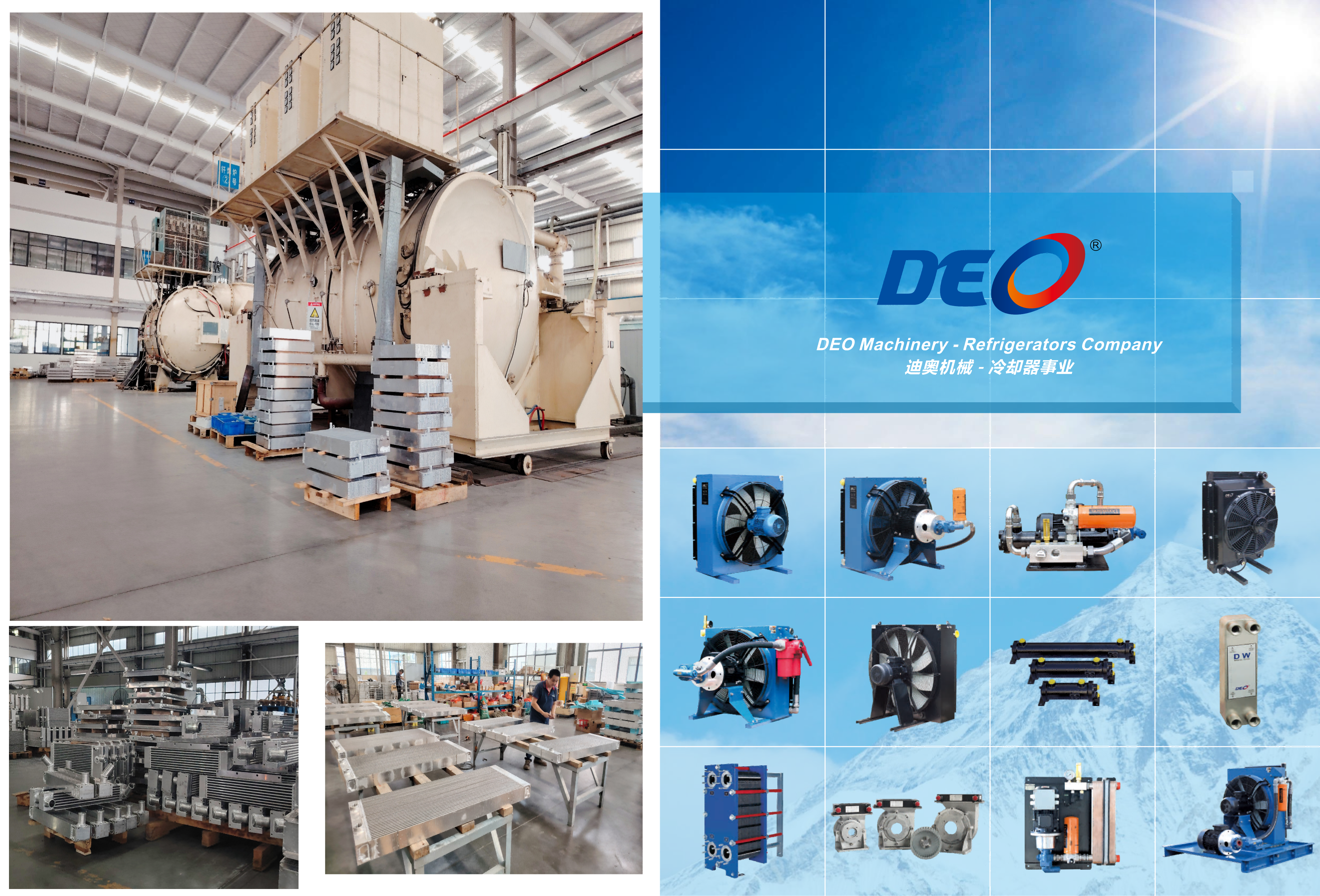
DEO documents a 1-unit minimum order quantity, a 35–45 day lead time and a monthly capacity of 2,500 units, with OEM/ODM customization covering colour and oil pump configuration. For a project schedule, that lead time belongs in the installation plan rather than after it, because the inlet and cooler checks above need to be completed before first start-up. Buyers who want to confirm a configuration against their own duty description can request a sample or quotation through Deo Machinery Co., Ltd, and the product brochure below lists the models covered in this guide.
Conclusion
The selection logic on a smart manufacturing line is a sequence, not a single decision: define the duty, choose the pump whose displacement and direction match it, then choose the cooler that removes the heat that duty generates. On that sequence, continuous high-viscosity lubrication points to the DK630, reversing hydraulic circuits to the PST180, smaller independent loops to the PSN100, and heat rejection to the DFLSL-10, DWBW-408-T or DFLEX8 depending on whether the plant has water, needs a separated loop, or has neither. The installation checks — airtight inlet, clean oil, correct rotation, no dry running, ventilation and viscosity correction — determine whether those choices hold once the line is running.
Deo Machinery Co., Ltd documents the pumps and coolers discussed here, together with the factory, testing and customization details buyers need for a project review. The company website is Deo Machinery Co., Ltd, and the full product brochure is available for download: DEO industrial lubrication pump and cooler brochure (PDF).
Have Questions or Need More Details?
Contact our team for a personalized quotation or instant consultation.
Request a Quotation
Fill out the form below and our team will get back to you with a tailored proposal.
WhatsApp Direct Chat
Prefer to chat in real-time? Message us on WhatsApp for instant assistance & quick answers.
- Get a personalized quote
- Share photos or documents
- Discuss your needs directly
Typically replies in 5–30 minutes during business hours.