
Verifying Industrial Lubrication Pump Compliance Documents
An industrial lubrication pump is specified on its ratings and accepted on its documentation. For a buyer sourcing an electric lubrication pump, a bidirectional pump or a lubrication system oil cooler, the compliance question is rarely “does the supplier have a certificate?” It is “can the supplier produce a document pack that matches this model, this duty point and this destination market?” Those are different questions, and only the second one protects a purchase order.
This guide sets out a verification method for four buying regions — Europe, America, Southeast Asia and Australia — and applies it to the DEO product families covered by verified records: the DK630 electric lubrication pump in QT500 ductile iron at 630 cc/rev, the PST180 and PSN100 bidirectional pumps, and the DWBW-408-T water cooler, DFLSL-10 self-circulating cooler and DFLEX8 wind cooler. Deo Machinery Co., Ltd is a Ningbo-based manufacturer of hydraulic pumps, electric lubrication pumps, centralized lubrication system pumps, oil lubrication pump systems and lubrication system oil coolers, founded in 2010, with stated export markets including Europe and America, Southeast Asia and Australia. The same document questions therefore follow the same products into each of those markets.
One rule governs everything below: this guide asserts only what has been verified. Where a specific certificate, marking or national regulation is not present in the source records, the article says so and describes the verification step, rather than naming a requirement that has not been evidenced. An unsupported certificate claim is a defect in an offer, not a reassurance.
The compliance problem: a certificate answers a different question than a datasheet
Three document types get confused in procurement, and the confusion is expensive. A quality management certificate proves that a manufacturer operates a certified process within a defined scope. A declaration of conformity states which directives and standards a product has been assessed against, and who signed that assessment. A datasheet states ratings — displacement, pressure, temperature, flow — under stated conditions. None of the three substitutes for another, and a file containing only one of them cannot support an acceptance decision.
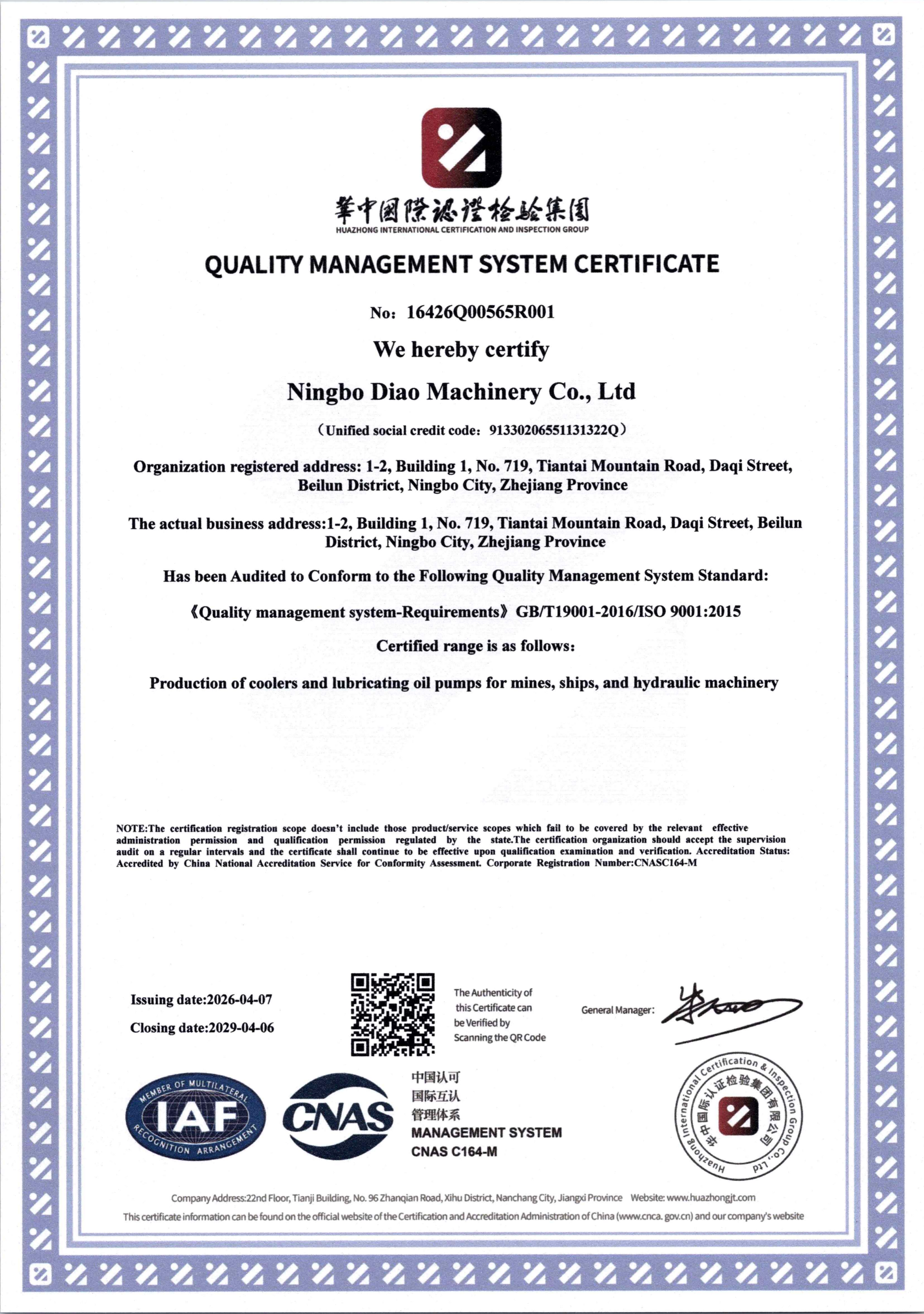
Scope drift is the second failure. A certificate issued for a factory is not evidence for a model, and a scope line that names coolers is not evidence for pumps. DEO’s ISO 9001 record shows how precise this can be made: certificate 16426Q00565R001, issued on 2026-04-07 by Huazhong International Certification and Inspection Group and valid to 2029-04-06, is written against GB/T 19001-2016/ISO 9001:2015 with a scope of “production of coolers and lubricating oil pumps for mines, ships, and hydraulic machinery.” That single sentence covers both product families and three application sectors — and it still does not state that a DK630 running at 630 cc/rev is conformant for your installation. That statement belongs to a declaration of conformity and the technical file behind it.
How compliance is documented in this category
Published manufacturer documentation shows the format buyers should expect. SKF’s documentation for its FK grease lubrication pump unit lists the directives and standards applied in the respective applicable areas: Machinery Directive 2006/42/EC, RoHS II 2011/65/EU, Electromagnetic Compatibility 2014/30/EU, and standards EN ISO 12100:2010, EN 809:1998+A1:2009/AC:2010, EN 60204-1:2018, EN 60947-5-1:2004/A1:2009 and EN IEC 60947-5-2:2020 (SKF product documentation, 2026). The commercial value of that list is not its length. It is that each entry carries an identifier and an edition year, which means each can be checked, version-controlled and quoted in a contract.
Sector-specific standards exist alongside the general ones. ASTM F2798-09(2023) defines requirements for the design, construction and testing of sealless, rotary positive displacement pumps with oil-through motors for ship lubricating oil service, and applies to canned lube oil pumps handling oil with an SAE rating of 20–50. A standard industrial lubrication pump sits outside that scope, and a marine specification sits outside the scope of a general datasheet. Matching standard to application is a buyer-side step that no supplier can perform on your behalf.
Trade classification completes the file. In the US Harmonized Tariff Schedule, pumps sit under heading 8413, with 8413.30.90 recorded for the pump scope used in this guide. For supplier qualification, NAICS 333996 covers establishments making fluid power pumps and motors, while fluid pumps for motor vehicles — oil pumps, water pumps, power steering pumps — are classified separately in Industry Group 3363. Both facts matter for a mundane reason: a customs entry and a supplier classification claim are only as good as the code behind them, and “pump manufacturer” means little until that code is confirmed.
The six-document pack to request before technical evaluation
A verified compliance file for a lubrication pump or oil cooler contains six document types. Request them by name, number and revision, and record the date received.
1. Quality management certificate. Ask for the certificate number, the standard version, the issuing body, the issue and expiry dates, and — most importantly — the exact scope wording. A scope that names the product families you are buying is usable; a scope that names a different product line is not, however familiar the logo on it.
2. Declaration of conformity and its standards list. The declaration should name the directives applied, the referenced standards with edition years, the product identification including model, and the signature. The SKF example above is a usable reference format. If a declaration covers a series rather than a model, confirm in writing that your model is inside the series definition, because a series document does not automatically extend to a customized configuration.
3. Model datasheet with ratings and conditions. A number without a condition cannot be verified. The DWBW-408-T cooler, for example, is rated at a maximum working pressure of 16 bar on the oil side and 10 bar on the water side, with an allowable oil medium temperature of ≤120 °C, cooling water at 5–60 °C and an applicable oil kinematic viscosity of 12–320 mm²/s. Those conditions define the envelope in which the rating is valid; a purchase order quoting the pressure without the temperature and viscosity is quoting a fragment.
4. Material and component declaration. Material affects both conformity screening and spares planning. The DK630 electric lubrication pump is specified in QT500 ductile iron; PSN100 in QT500 ductile iron; PST180 with a housing in either GG250 grey cast iron or QT500 ductile iron. The DWBW-408-T declares its bill of materials in usable detail: steel shell, mounting bracket, baffles and end plates; aluminium cooling fins, with copper available as a customization; copper tubes, with nickel available as a customization; cast iron end caps; nitrile rubber gaskets. A quotation that does not state which housing material is included on a PST180 is not yet a specification.
5. Test record. DEO states 100% testing in its production process. The verification question is what “100%” covers: which parameters are measured on every unit, at what tolerance, and whether the record travels with the unit serial number. A test certificate that cannot be tied to the delivered unit is an inspection claim rather than evidence.
6. Commercial and acceptance terms. MOQ, lead time, capacity and customization scope belong in the same file, because they determine whether the technical agreement can be executed. DEO’s capability record states an MOQ of 1 unit, a lead time of 35–45 days, monthly capacity of 2,500 units, OEM/ODM production, and customization of colour and oil pump configuration. Those terms should be fixed in writing before the technical evaluation closes, not negotiated afterwards.
| Document | Question it answers | What it does not prove |
|---|---|---|
| Quality management certificate | Is the manufacturing process certified, and does the scope name these product families? | Conformity of a specific model to a specific directive |
| Declaration of conformity | Which directives and standards were applied, and who signed? | That the delivered unit matches the assessed configuration |
| Model datasheet | What are the ratings, and under which conditions? | Compliance route and material composition |
| Material declaration | What is the pump or cooler made of, and which options apply? | Performance under your specific duty cycle |
| Test record | What was measured on this unit serial? | Independent verification of the test method |
| Commercial terms | Can the order be executed exactly as specified? | Technical suitability for the application |
Regional checkpoints: what to demand in Europe, America, Southeast Asia and Australia
Regional requirements differ, and so does the quality of public evidence about them. The section below separates what is verified in this guide’s source records from the action a buyer must take. Where no specific requirement is recorded, the honest instruction is to obtain the requirement list locally — not to assume that none exists.
Europe. The verified reference point is the directive and standard set reproduced in SKF’s product documentation: 2006/42/EC, 2011/65/EU and 2014/30/EU, with EN ISO 12100:2010, EN 809:1998+A1:2009/AC:2010, EN 60204-1:2018 and the two EN 60947 entries. For a pump or cooler destined for an EU installation, the buyer’s task is to obtain the equivalent list for the exact model and to check four things: the edition year of each standard, whether the electrical drive and controls sit inside the assessed configuration, whether RoHS scope covers the components actually supplied, and whether the equipment is delivered as a complete assembly or as a partly completed machine. The last point changes which declaration applies, and it is a frequent source of mismatch between a supplier’s file and an integrator’s expectation.
America. Two verified items are directly usable. ASTM F2798-09(2023) governs sealless rotary positive displacement pumps with oil-through motors for ship lubricating oil service, including canned lube oil pumps handling SAE 20–50 oil — relevant if the pump serves a marine lubrication circuit, irrelevant otherwise. For customs and supplier classification, heading 8413 with subheading 8413.30.90, together with NAICS 333996 and its exclusion of motor-vehicle fluid pumps to Industry Group 3363, provides the framework. This guide does not record a US product-safety certification requirement for general industrial lubrication pumps; where the installation is regulated, the applicable requirement should be obtained from the authority having jurisdiction and written into the purchase order as a named standard.
Southeast Asia. No national requirement for lubrication pumps is verified in this guide’s evidence, and none is invented here. The practical route for a buyer in the region is to work from the importer of record: obtain the national requirement list that applies to the equipment, require the supplier’s declaration and standards list in the same format used for Europe, and confirm that the electrical configuration matches the local supply. Market fit is a compliance issue, not a commercial nicety — the DFLEX8 wind cooler, for instance, is specified with a 3φ380 motor, so the supply voltage at the destination must be confirmed and documented before the order is released.
Australia. The same logic applies. This guide’s records do not establish a specific Australian marking requirement for these products, so the verification step is to obtain the applicable requirement from the Australian importer or regulator, then hold the supplier to it in the same document format: named standard, edition, model identification, signature. A supplier that can produce an edition-dated standards list for Europe can normally produce the equivalent for another market; a supplier that can produce neither should not be shortlisted.
| Region | Verified reference in this guide | Buyer action |
|---|---|---|
| Europe | Directive and standard list published in SKF lubrication pump documentation: 2006/42/EC, 2011/65/EU, 2014/30/EU, EN ISO 12100, EN 809, EN 60204-1, EN 60947-5-1, EN IEC 60947-5-2 | Obtain the model-specific declaration and confirm standard editions, electrical scope and assembly status |
| America | ASTM F2798-09(2023) for marine lube oil pumps; HS 8413.30.90; NAICS 333996 with motor-vehicle pumps under 3363 | Match the standard to the application, confirm the classification code, obtain any regulated requirement locally |
| Southeast Asia | No product-specific national requirement recorded here | Obtain the national requirement list via the importer of record; confirm supply voltage and motor configuration |
| Australia | No product-specific national requirement recorded here | Obtain the requirement from the Australian importer or regulator; require the same document format |
Step-by-step: verifying a pump or cooler before the deposit
- Lock the model and configuration. DK630 at 630 cc/rev with motor speed 950 or 1450 rpm; PST180 at 180 cc/rev, maximum 1,800 rpm, −30 °C to +100 °C; PSN100 at 100 cc/rev, maximum 1,800 rpm, −30 °C to +100 °C; DWBW-408-T, DFLSL-10 or DFLEX8 with the stated cooling capacity and flow variant. A compliance file for “a pump” is not a compliance file.
- Write the operating envelope. Viscosity, oil temperature, ambient conditions, pressure and flow. The DK series documentation, for example, covers a kinematic viscosity range of 12–20,000 cSt and a fluid temperature range of −40 °C to +100 °C; the DWBW-408-T covers 12–320 mm²/s with oil at ≤120 °C. Your duty point should sit inside a documented range with margin, not on its edge.
- Request the six documents by number and revision, with a required-return date attached.
- Cross-check ratings against the envelope item by item, and record every deviation in writing rather than resolving it verbally.
- Check standard editions and dates. An undated standard reference cannot be verified, and a superseded edition cannot be assumed to be equivalent.
- Check that the certificate scope names the product families and the manufacturing site behind the order.
- Write acceptance criteria and inspection rights into the purchase order, tied to the test record and to the agreed lead time.
- Archive the pack with its revisions and set a re-verification date. DEO’s ISO 9001 certificate expires on 2029-04-06. Expiries, standard revisions and model changes are the three events that invalidate a previously accepted file.
Acceptance criteria and purchasing terms worth fixing in writing
Acceptance criteria convert a datasheet into an enforceable order. Six clauses cover most of the risk: model and displacement with the exact configuration; material, including which housing option applies to a PST180 order; ratings with their conditions rather than bare numbers; the test record, naming the parameters measured and the unit serial; marking and nameplate content, so the delivered unit can be matched to the file; and document delivery deadlines, draft at order confirmation and final at shipment.
Purchasing terms belong in the same conversation. DEO’s stated terms — MOQ 1 unit, lead time 35–45 days, monthly capacity 2,500 units, OEM/ODM production, customization of colour and oil pump configuration — define what can be promised and when. A 45-day lead time plus a two-week documentation review is a 59-day programme, not 45. Scheduling the review inside the lead time rather than after it is the difference between a controlled shipment and a held one.
Applying the pack to the six DEO models
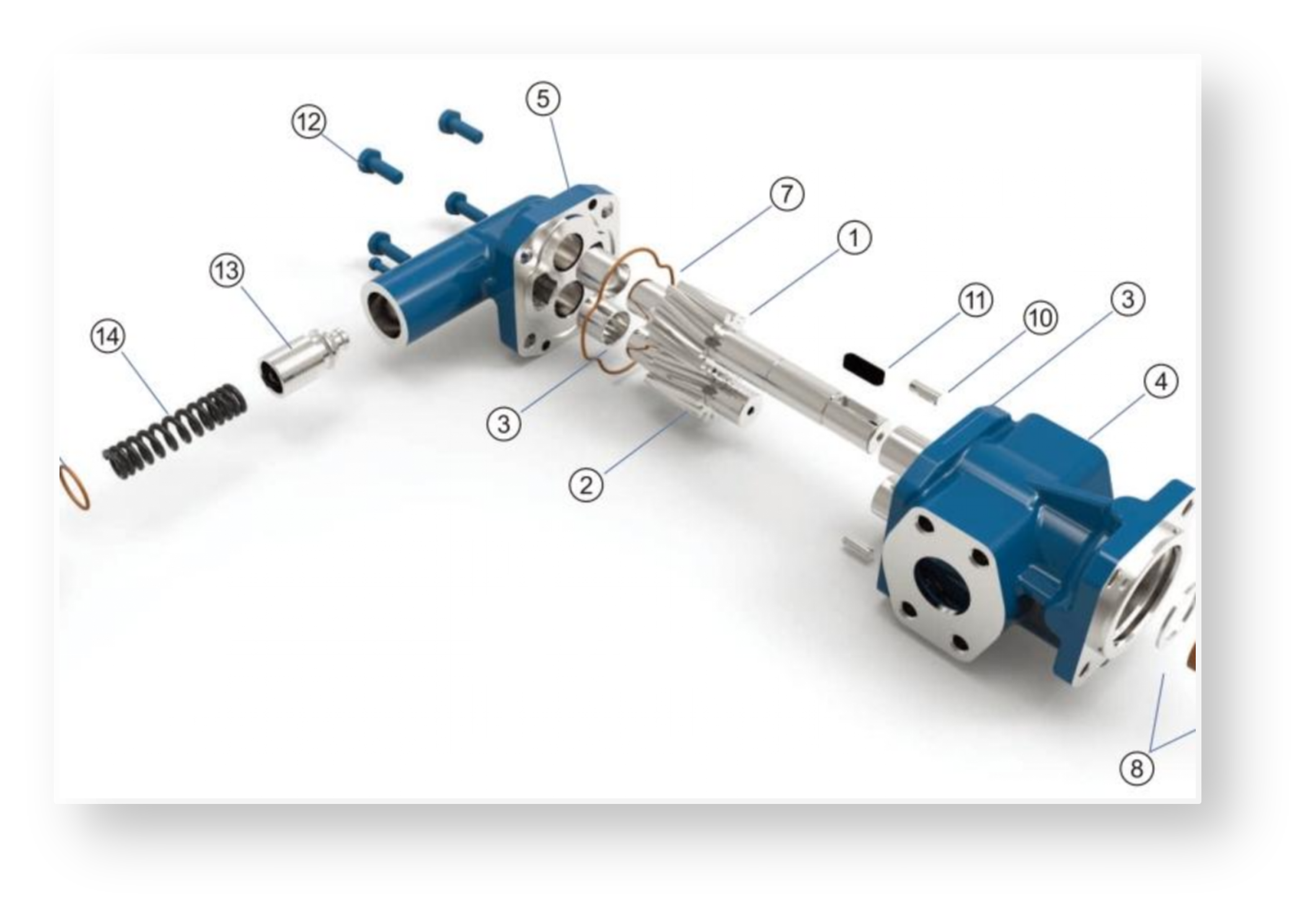
DK630 (electric lubrication pump). 630 cc/rev displacement, motor speed 950 or 1450 rpm, QT500 ductile iron, positioned for machinery and heavy industry. For mining, construction machinery and steel applications, three documented items travel with the pump: the material declaration, the DK series performance envelope of 12–20,000 cSt at −40 °C to +100 °C, and the built-in relief valve range of 5–25 bar. The relief valve is a documentation point as much as an engineering one, because a protection device whose set pressure is unrecorded cannot be audited at commissioning. SKF’s pump documentation makes the same point from another direction by specifying a maximum opening pressure of 270 bar for a pressure relief valve on each pump element: the protection value is published, not implied.
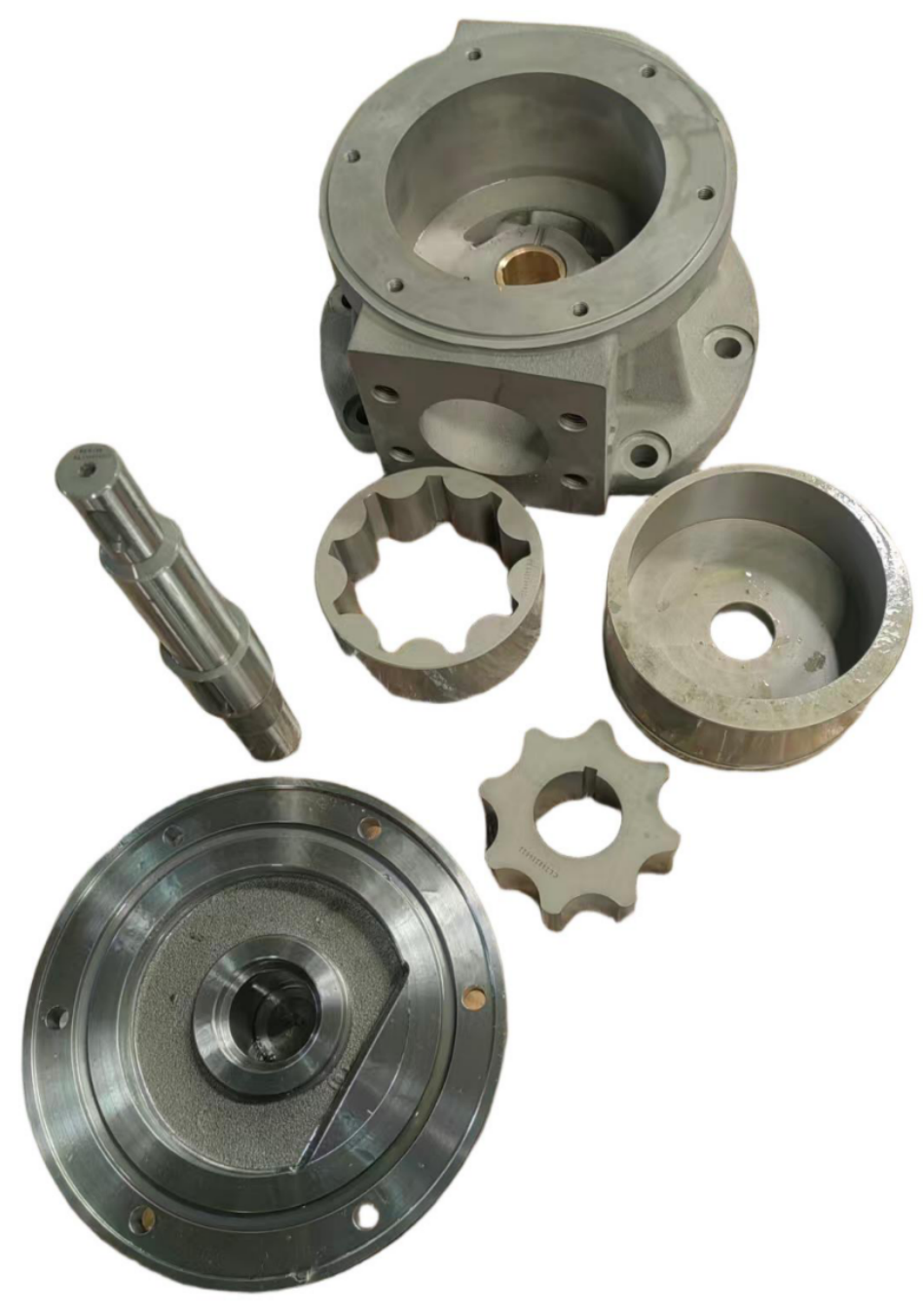
PST180 and PSN100 (bidirectional pumps). PST180 delivers 180 cc/rev to a maximum of 1,800 rpm with a housing in GG250 grey cast iron or QT500 ductile iron; PSN100 is a trochoidal bidirectional pump at 100 cc/rev and 1,800 rpm in QT500 ductile iron. Both are rated from −30 °C to +100 °C. The compliance-sensitive detail here is optionality: a bidirectional pump quoted without a housing material is not a specification, and a declaration written for one housing material does not cover the other. State the option first, then verify the declaration against it.
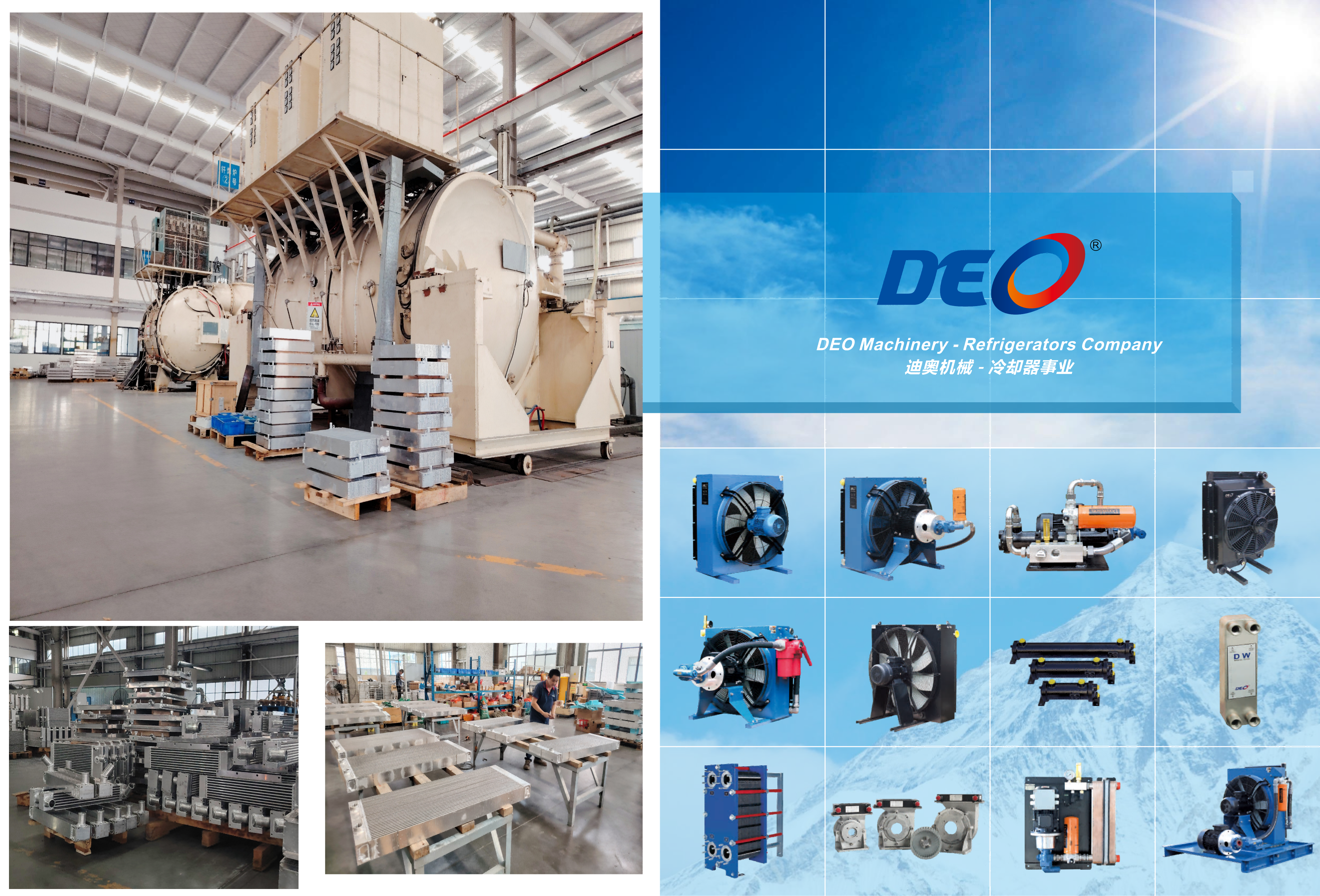
DWBW-408-T (oil/water cooler). 16 bar on the oil side, 10 bar on the water side, oil ≤120 °C, water 5–60 °C, viscosity 12–320 mm²/s, with a detachable end cover for cleaning. The customization path is where documentation earns its keep: a stainless steel shell, 304 stainless fins or nickel tubes for corrosive or seawater duty change both the material declaration and the maintenance instruction. A seawater installation supplied against a standard material declaration is a documentation failure before it becomes a corrosion failure.
DFLSL-10 (self-circulating cooler). Cooling capacity 1.61/1.84 kW/°C, oil pump flow at VG46 of 100–125 L/min or 150–200 L/min, consumed power 5.5/7.5 kW. The DFLS series description documents an independent closed self-circulation loop separated from the host hydraulic circuit; for a DFLSL-10 order, the acceptance file should therefore record which flow variant was ordered and which power supply the unit carries, because the two variants do not share a single specification line.
DFLEX8 (wind cooler). Comparative cooling capacity 1.15/0.91 kW/°C, fan diameter 630 mm, motor 3φ380. The voltage is the first item to confirm against the destination market’s supply; the second is the fan and drive configuration inside the declared scope. Wind-sector buyers typically also require the cooling capacity to be quoted with its comparison basis, since a comparative figure is only meaningful against the reference it is compared with.
Frequently asked questions
What should buyers check in CE-certified industrial lubrication pump manufacturers?
CE marking on machinery follows a declaration route rather than a certificate issued by a regulator: the manufacturer or its authorised representative issues a declaration of conformity naming the directives and standards applied and holds the technical file behind it. SKF’s published lubrication pump documentation shows the expected content — Machinery Directive 2006/42/EC, RoHS II 2011/65/EU, EMC 2014/30/EU and the referenced EN standards with edition years. Verification is therefore document-level: request the declaration of conformity for the exact model, confirm that the model number, directives and standard editions match what you are buying, and check who signs it. A CE logo without a model-specific declaration is not verification. In this guide, DEO’s verified certification record is ISO 9001 — certificate 16426Q00565R001 for coolers and lubricating oil pumps for mines, ships and hydraulic machinery, valid to 2029-04-06 — and CE documentation should be requested and reviewed per model, since no CE certification is asserted here.
Does an ISO 9001 certificate cover the specific pump I am buying?
Only to the extent the scope wording says so. Read the scope line, the standard version, the issuing body and the validity dates, then compare the named product families with the item on the order. DEO’s scope names coolers and lubricating oil pumps for mines, ships and hydraulic machinery, which is a match for the DK630, PST180, PSN100, DWBW-408-T, DFLSL-10 and DFLEX8 — but a quality system certificate still does not certify a model’s conformity to a product directive or confirm a pressure rating.
Which purchasing terms should be fixed before a compliance file is accepted?
MOQ, lead time, monthly capacity, customization scope and document delivery dates. DEO’s stated terms are MOQ 1 unit, lead time 35–45 days, monthly capacity 2,500 units, and OEM/ODM production with customization of colour and oil pump configuration. Fix these in writing before the technical review closes, and schedule the documentation review inside the lead time rather than after it.
How is a delivered sample validated against the document pack?
Compare nameplate, datasheet and declaration as one set. The nameplate model and serial number must match the datasheet configuration and the product identification in the declaration; then check the sample against the stated conditions — for a DWBW-408-T, that means oil-side pressure, water-side pressure, oil temperature and viscosity together, not pressure alone. Request the test record for the sampled unit where one is available, and record any deviation before approving series supply.
When should compliance documents arrive relative to shipment?
Two deadlines are workable. Draft documents at order confirmation, so a mismatch is found while the configuration can still change; final documents with the shipment, so the file matches the delivered unit serial. With a 35–45 day lead time, a review that starts only at shipment turns every documentation gap into a delay at the buyer’s dock. If the destination market requires a specific declaration, state it at the sample or quotation stage so it is built into the order rather than added afterwards.
Conclusion
Compliance for an industrial lubrication pump or oil cooler is not a badge that a supplier either has or lacks. It is a set of documents whose value depends on matching three things at once: the exact model and configuration, the duty envelope it will run in, and the market it will enter. The verified elements in this guide — a scoped ISO 9001 certificate, published directive and standard lists from manufacturer documentation, sector standards such as ASTM F2798-09(2023), trade classifications under 8413.30.90 and NAICS 333996, and the declared ratings of the DK630, PST180, PSN100, DWBW-408-T, DFLSL-10 and DFLEX8 — are the raw material of that file, not the file itself.
The buyer’s discipline is easy to state and harder to keep: request the six documents by number and revision, cross-check every rating against its conditions, confirm that each declaration names the model being bought, and write acceptance criteria into the purchase order before the deposit. Where a requirement is not evidenced — as with specific Southeast Asian and Australian requirements in this guide — obtain it locally rather than assuming it away. That is what separates a compliance file from a decorative folder.
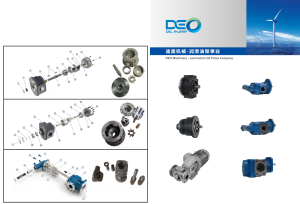
Deo Machinery Co., Ltd publishes its product information at www.cndeo.com, and the company catalogue covering lubrication pumps and oil cooling equipment is available for download here: DEO product catalogue (PDF). Buyers assembling a compliance pack can request the datasheets, material declarations and available test records for the DK630, PST180, PSN100, DWBW-408-T, DFLSL-10 and DFLEX8 as the starting point for the six-document review described above.
Have Questions or Need More Details?
Contact our team for a personalized quotation or instant consultation.
Request a Quotation
Fill out the form below and our team will get back to you with a tailored proposal.
WhatsApp Direct Chat
Prefer to chat in real-time? Message us on WhatsApp for instant assistance & quick answers.
- Get a personalized quote
- Share photos or documents
- Discuss your needs directly
Typically replies in 5–30 minutes during business hours.