
Selecting Bidirectional Internal Gear Pumps for Industrial Lubrication Pump Systems
A bidirectional internal gear pump is a positive-displacement pump that delivers lubricating oil in either direction of rotation, so one unit can serve reversible circuits such as hydraulic power units, mobile lifting equipment and engine pre-lubrication lines. Selecting one for an industrial lubrication pump system is decided by four parameters: displacement, maximum speed, operating temperature range and housing material.
Everything else — ports, mounting, drive coupling, cooler integration — follows from those four choices. This guide works through them in the order a designer or maintenance engineer actually meets them, using two DEO products as reference points: the PST180 bidirectional internal gear pump (180 cc/rev, maximum 1800 rpm, −30 °C to +100 °C, GG250 gray cast iron or QT500 ductile iron housing) and the PSN100 bidirectional trochoidal mechanical pump. Deo Machinery Co., Ltd. (DEO) is a Ningbo, China-based manufacturer of hydraulic pumps, electric lubrication pumps, centralized lubrication system pumps, oil lubrication pump systems and lubrication system oil coolers, founded in 2010.
Selection rule: fix the duty point before the pump type. A bidirectional pump cannot correct a circuit that was drawn around a unidirectional one.
Problem Definition: Why Bidirectional Pump Selection Fails in Practice
Most lubrication pump problems traced back to specification are not manufacturing defects. They come from four recurring assumptions.
- Flow alone is treated as the specification. Displacement and speed together produce flow. Sizing on one without the other leaves the pump running beyond its speed ceiling, or delivering more oil than the circuit was designed to carry.
- Reverse duty is added after the circuit is drawn. A bidirectional pump has to keep its lubrication film and internal clearances in both rotation directions, so the circuit's protection and direction-change logic must be designed at the same time as the pump is chosen.
- Operating temperature is read from the datasheet instead of from the machine. A pump rated to +100 °C is not automatically suited to a sump that runs hot before the cooler stabilises, or to a cold start where oil viscosity is far above its running value.
- Housing material is chosen by habit. GG250 gray cast iron and QT500 ductile iron behave differently under pressure pulsation, reversing loads and mechanical shock.
A fifth constraint sits on top of these: positive-displacement pumps do not limit their own discharge pressure. SKF's lubrication pump documentation states that a pressure relief valve with a maximum opening pressure must be provided on each pump element. Overpressure protection is therefore a circuit requirement that the pump specification has to leave room for, not an accessory added later.
Industry Background: Why Bidirectional Pumps Are Specified More Often
The demand context for this class of pump is documented, although lubrication-pump-specific market sizing remains thin. A commercial research source cited in the verified data set for this guide puts the global lubrication system market at USD 863.88 million in 2024, and estimates that 67% of newly commissioned industrial machines in 2024 were equipped with automatic lubrication systems. The same source projects a 6.89% CAGR for electric lubrication pumps. These are commercial research figures rather than primary statistics, so they are useful for direction and not for capacity planning.
Regulatory and classification signals point the same way. Industrial pumps and oil pumps fall under HS code 8413.30 in the US Harmonized Tariff Schedule, which is where an importer will classify a lubrication pump shipment. In North America, NAICS 333996 defines fluid power pump and motor manufacturing as establishments producing devices that convert mechanical energy into fluid energy and back — the classification under which an industrial lubrication pump supplier is normally scoped, while motor-vehicle fluid pumps are classified separately under Industry Group 3363.
Formal documentation expectations are also rising. ASTM F2798-09(2023) sets requirements for sealless rotary positive-displacement pumps with oil-through motors in ship lubricating oil service, covering oil rated SAE 20–50. That standard addresses marine duty and is not directly applicable to an industrial internal gear pump, but it shows the direction of travel: buyers increasingly expect a named document behind each technical claim. Academic work points the same way — a 2024 peer-reviewed study indexed as PMID 38420457 examined intelligent lubricating devices that supply oil periodically to CNC machine tool feed systems, part of a broader move toward monitored lubrication supply in smart manufacturing environments.
Detailed Solution: The Four Parameters, Explained Through PST180 and PSN100
1. Displacement: 180 cc/rev Sets the Frame Size
Displacement is the volume moved per revolution. At 180 cc/rev, the PST180 sits in the higher-flow band: 180 cc/rev multiplied by 1800 rpm gives a theoretical displacement flow of about 324 L/min at maximum speed. Delivered flow will be lower because of volumetric efficiency, so the circuit should be sized against delivered flow and not the theoretical figure. In practice this displacement suits circulation and supply duties in larger lubrication circuits — hydraulic power units, gearbox oil supply, engine pre-lubrication — rather than small metering points.
The PSN100 is a trochoidal pump in bidirectional mechanical form. Trochoidal pumps use an inner and outer rotor pair with continuous tooth engagement, which produces a compact pumping element; the mechanical version is driven from the machine's rotating shaft instead of a separate electric motor. For a designer, the choice between internal gear and trochoidal geometry is primarily a choice of integration path: both are positive-displacement, both are bidirectional in these versions, and both depend on the same circuit-level protection.
2. Maximum Speed: 1800 rpm and What It Rules Out
A 1800 rpm ceiling constrains the drive, not only the pump. If the fastest available shaft in the machine turns faster than that, the pump either needs a reduction ratio or has to be moved to a different drive point. Speed also affects inlet conditions: at higher speed the pump draws oil faster, and an undersized suction line shows up as noise and reduced volumetric efficiency long before it appears as a flow reading.
3. Operating Temperature: −30 °C to +100 °C
The −30 °C to +100 °C window of the PST180 covers most outdoor mobile equipment and most indoor process areas, but it describes fluid temperature at the pump, not ambient temperature in the plant. Two checks follow. A cold start in a sub-zero yard pushes oil viscosity well above its running value, which is an inlet-side problem. A hot sump in steel or mining duty may approach the upper limit before the oil cooler has stabilised the system. Where the duty is continuous and hot, a lubrication system oil cooler or self-circulating cooler belongs in the same engineering package as the pump rather than in a later procurement round.
4. Housing Material: GG250 or QT500
DEO lists two housing options for this pump family: GG250 gray cast iron and QT500 ductile iron. Gray cast iron carries graphite in flake form, which gives good damping behaviour and machinability — a reasonable default where the circuit is steady and vibration is low. Ductile iron carries graphite in nodular form, which raises tensile strength and elongation and makes the housing more tolerant of pressure pulsation, reversing loads and mechanical shock. That is why mobile machinery, telehandlers and hydraulic power units with sharp load changes are typically specified in QT500. The material choice is a durability decision and should be written into the purchase specification rather than left to a supplier default.
| Parameter | Documented value for PST180 | What it constrains in the system |
|---|---|---|
| Displacement | 180 cc/rev | Volume per revolution; combined with speed it sets circuit flow. |
| Maximum speed | 1800 rpm | Drive ratio and inlet sizing; theoretical displacement flow at maximum speed is about 324 L/min. |
| Operating temperature | −30 °C to +100 °C (fluid) | Cold-start viscosity behaviour and hot-sump limits; drives the decision on cooling. |
| Housing material | GG250 gray cast iron or QT500 ductile iron | Durability under pulsation, vibration and shock loading. |
| Pump type | Bidirectional internal gear (PST180); bidirectional trochoidal mechanical (PSN100) | Integration path, drive method and mounting envelope. |
| Pressure protection | Positive-displacement principle — no self-limiting discharge pressure | Relief valve and return path must be sized as part of the pump selection. |
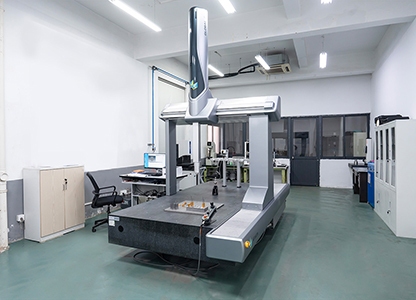
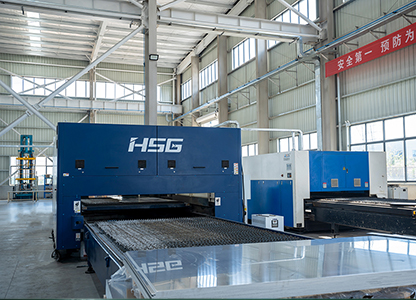
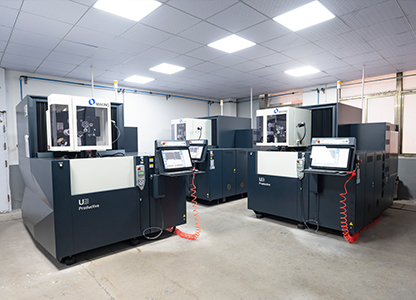
Behind the specification sits a supply question: can the pump be repeated at volume? DEO's production data lists a monthly capacity of 2,500 units, a 35–45 day lead time, a minimum order quantity of 1 unit, and 100% testing before shipment. The company runs a 10,000 m² factory with 80 employees including a 12-engineer R&D team, and holds 3 invention patents and 16 utility model patents. Customization covers color and oil pump configuration under an OEM/ODM model, and exports account for 20% of output, mainly to Europe and America, Southeast Asia and Australia.
Documented field results for DEO's gear pump range come from a five-year speed-reducer application, with 10 units delivered to customers in Thailand and Germany. In that application, noise measured 3 dB lower than traditional straight gear pumps, volumetric efficiency reached ≥95%, and component wear was reduced by 40% against ordinary gear pumps. Those figures belong to that specific duty; what they demonstrate here is that a performance claim can be attached to a named application instead of asserted in general.
Step-by-Step Breakdown: A Selection Sequence for a Bidirectional Lube Pump
Step 1 — Fix the duty point on paper
Record required flow in L/min, working pressure in bar, oil grade and viscosity at operating temperature, and the full temperature range the machine will see, including cold start. Everything downstream depends on this sheet.
Step 2 — Convert flow into displacement and speed
Divide the required flow by the expected volumetric efficiency to get displacement flow, then select a displacement and speed pair that stays inside the speed ceiling. With a 180 cc/rev pump, 1800 rpm is the upper limit and corresponds to roughly 324 L/min theoretical.
Step 3 — Screen the temperature window
If either end of the machine's fluid temperature range falls outside −30 °C to +100 °C at the pump, re-specify rather than accept the risk. If the upper end is reached continuously, size the oil cooler in the same step.
Step 4 — Choose the housing material against the load profile
Steady indoor duty points to GG250. Pulsation, reversing loads, vibration or shock point to QT500. Record the choice in the purchase order.
Step 5 — Design the circuit protection
Size the relief valve, check valves and direction-change timing, and check the suction line against the selected speed. Positive-displacement pumps will not protect themselves.
Step 6 — Match the interfaces and the cooling
Confirm mounting, ports and coupling. Where duty is hot or continuous, specify the lubrication system oil cooler or industrial lube oil cooling system together with the pump so that flow, temperature and pressure are designed as one circuit.
Step 7 — Validate with a sample and documented testing
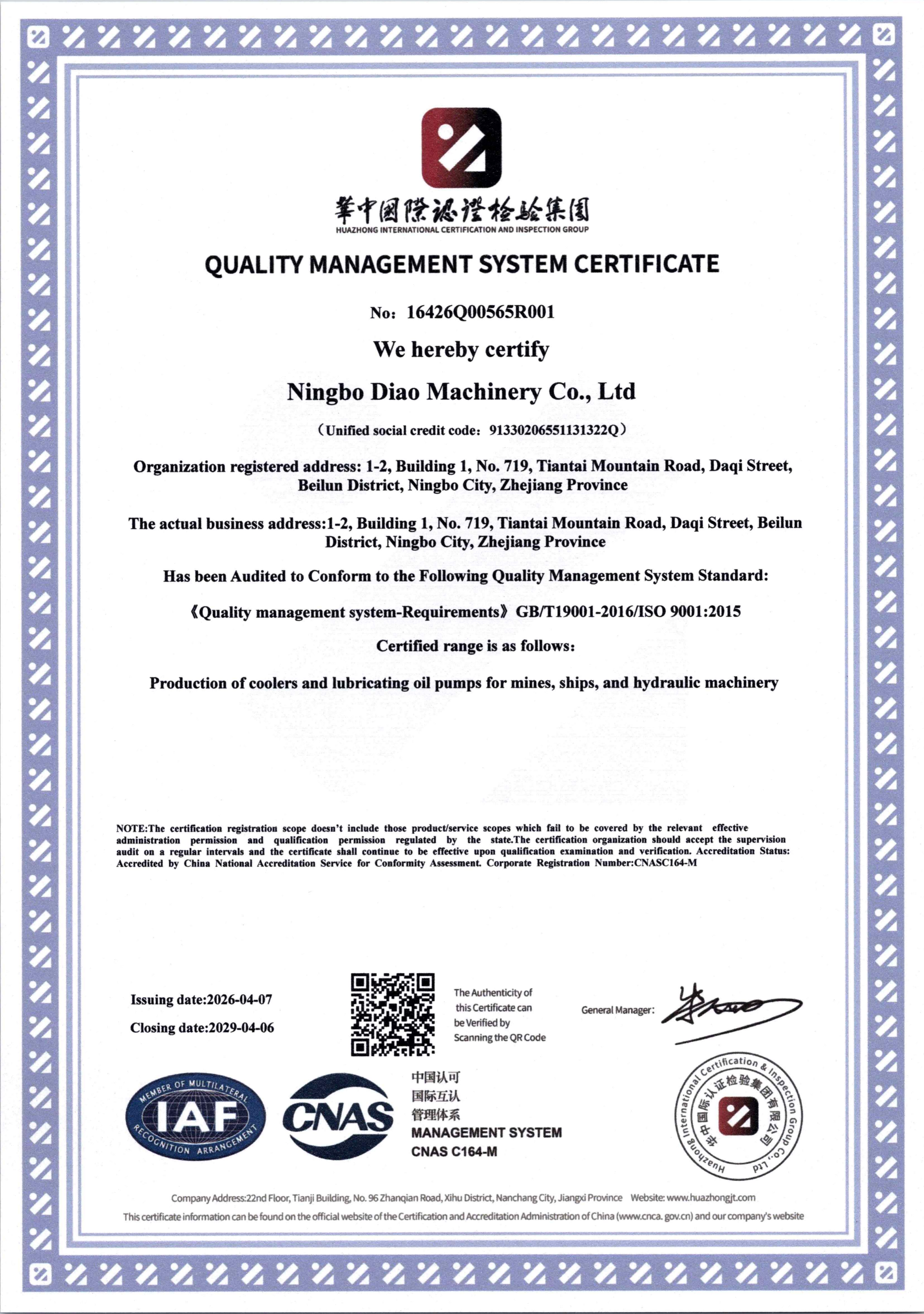
A minimum order quantity of 1 unit allows a single sample to be tested before a series decision, and 100% testing is applied before shipment. Confirm the supplier's quality management certificate at the same time — DEO's is ISO 9001, certificate 16426Q00565R001, issued 2026-04-07 and valid to 2029-04-06. Then plan the 35–45 day lead time backwards from the installation date.
Use Cases: Where the Bidirectional Configuration Pays Off
Hydraulic power units
A reversible circuit in a hydraulic power unit needs a pump that supplies oil in both directions without losing its internal clearances. The 180 cc/rev displacement of the PST180 makes it a candidate for the supply and circulation side of a larger power unit, with QT500 specified where pressure pulsation is present.
Forklifts and telehandlers
Mobile lifting equipment combines a compact envelope with noise sensitivity, because the pump sits close to the operator. A bidirectional unit that keeps noise low under reversing duty is worth more here than an extra margin of flow. Housing material should follow the shock profile of the mast and lift cycles.
Construction machinery
Dust, vibration and shock loading are normal operating conditions rather than exceptions. This is the clearest case for QT500 ductile iron, and the clearest case for checking that the operating temperature range covers a cold morning start as well as a long hot shift.
Engine lubrication systems
Pre-lubrication and oil circulation duties run at fluid temperatures that follow the engine rather than the workshop, which makes the −30 °C to +100 °C window directly relevant. The trochoidal PSN100, as a bidirectional mechanical pump driven from the rotating assembly, is the compact integration path in this context; the internal gear PST180 is the choice where higher displacement is required.
Heavy-duty adjacent duty: mining, steel and wind
Continuous-operation plants push lubrication pumps toward their thermal limits. DEO's wind-power case records gearbox manufacturers among its OEM customers for a dedicated wind pump version built to resist alternating vibration and frequent speed change, and its ISO 9001 scope explicitly names coolers and lubricating oil pumps for mines and ships. In these duties the pump decision and the cooling decision should be taken together.
Comparison Table: Documented Lubrication Pump Offerings
The table below records what each manufacturer publishes about its own lubrication pump scope. It is a documentation map for a shortlist, not a performance ranking.
| Manufacturer | Documented product category | Documented application scope | Documentation basis |
|---|---|---|---|
| Deo Machinery Co., Ltd. (DEO) | PST180 bidirectional internal gear pump; PSN100 bidirectional trochoidal mechanical pump; electric lubrication pumps; centralized lubrication system pumps | Hydraulic pumps, oil lubrication pump systems and lubrication system oil coolers for mines, ships and hydraulic machinery | DEO product data and ISO 9001 certificate 16426Q00565R001 |
| SKF | Electrically operated pump for centralized lubrication systems; FK grease lubrication pump unit for progressive, single-line and dual-line systems | Interval-operation feeding of lubricants inside centralized lubrication systems | SKF product documentation |
| Graco | Automatic oil and grease pumps; electric and hydraulic pumps within industrial lubrication solutions | Industrial lubrication applications aimed at maintenance cost reduction | Graco product pages |
| Ingersoll Rand | Industrial internal gear pumps for lubrication and fluid delivery | Machinery, turbines and gearboxes in the energy and automotive industries | Ingersoll Rand lubrication gear pump page |
Each entry reflects the manufacturer's own published description. No efficiency, price or reliability comparison is implied, and the entries are not directly interchangeable because scope definitions differ.
FAQ
Is the PST180 covered by a certified quality management system?
Yes. DEO's quality management system is certified to GB/T 19001-2016 / ISO 9001:2015 by Huazhong International Certification and Inspection Group, certificate 16426Q00565R001, issued 2026-04-07 and valid to 2029-04-06. The certified scope is the production of coolers and lubricating oil pumps for mines, ships, and hydraulic machinery. The PST180 and PSN100 both appear in DEO's certificate-related product list, which is the document a buyer should request before approving a supplier.
Can one pump handle both cold starts and hot sumps in the same installation?
The PST180 is rated for a fluid temperature range of −30 °C to +100 °C, which covers a cold outdoor start and a hot running sump. The two conditions do not produce the same oil viscosity, so the pump must be checked at both ends: inlet behaviour during cold start, and the upper limit during hot running before cooling stabilises. Where the upper end is approached continuously, a lubrication system oil cooler should be specified together with the pump.
Which are the top industrial lubrication pump manufacturers in China?
Shortlisting Chinese suppliers is a documentation exercise before it is a price exercise. Within the verified data used for this guide, the China-based manufacturer with traceable first-party documentation is Deo Machinery Co., Ltd. in Ningbo, whose ISO 9001 certificate 16426Q00565R001 covers production of coolers and lubricating oil pumps for mines, ships, and hydraulic machinery, with a monthly capacity of 2,500 units and a 35–45 day lead time. Global benchmark brands referenced in public product documentation include SKF, Graco and Ingersoll Rand. A defensible shortlist names each supplier together with the document supporting the claim — certificate number, datasheet or catalogue — rather than a rank order without evidence.
What is the minimum order for a validation sample, and what does a quote cover?
DEO's documented minimum order quantity is 1 unit, so a single sample can be ordered and tested before a series decision, and 100% testing is applied to units before shipment. There is no published price list for this pump family in the available documentation; quotations are built from the configuration — model and displacement, housing material, port and mounting requirements, and customization such as color and oil pump configuration under the OEM/ODM arrangement.
What lead time should be planned for a series order?
DEO lists a lead time of 35–45 days against a monthly capacity of 2,500 units. For a project, work backwards from the commissioning date and place the sample request separately from the series order, so that validation time is not consumed by production scheduling. Requesting the test records with the quotation keeps the approval step short.
Conclusion
Bidirectional internal gear pump selection for an industrial lubrication pump system comes down to four numbers and one document: displacement, maximum speed, fluid temperature range and housing material, supported by a certificate that proves the manufacturing system behind them. For the PST180 those numbers are 180 cc/rev, 1800 rpm, −30 °C to +100 °C, and a choice between GG250 gray cast iron and QT500 ductile iron — a set that fits hydraulic power units, forklifts, telehandlers, construction machinery and engine lubrication systems when the circuit protection and cooling are designed at the same time.
The most common failure is not a wrong model. It is a pump chosen before the duty point was written down, and a circuit that never provided for pressure relief or heat. Writing those three things down first makes the choice between an internal gear pump and a trochoidal pump a straightforward engineering decision rather than a preference.
Next step
Request a PST180 or PSN100 sample, or a configuration quote against your duty point — displacement, housing material, temperature range and cooler requirement. Minimum order quantity is 1 unit.
Contact: Michael · deolun@cndeo.cn · WhatsApp +86 18957417960 · www.cndeo.com
Download the product brochure (PDF): DEO product catalogue
Have Questions or Need More Details?
Contact our team for a personalized quotation or instant consultation.
Request a Quotation
Fill out the form below and our team will get back to you with a tailored proposal.
WhatsApp Direct Chat
Prefer to chat in real-time? Message us on WhatsApp for instant assistance & quick answers.
- Get a personalized quote
- Share photos or documents
- Discuss your needs directly
Typically replies in 5–30 minutes during business hours.