
Industrial Lubrication Pump Comparison: Electric, Internal Gear, Trochoidal
Industrial Lubrication Pump Selection Guide
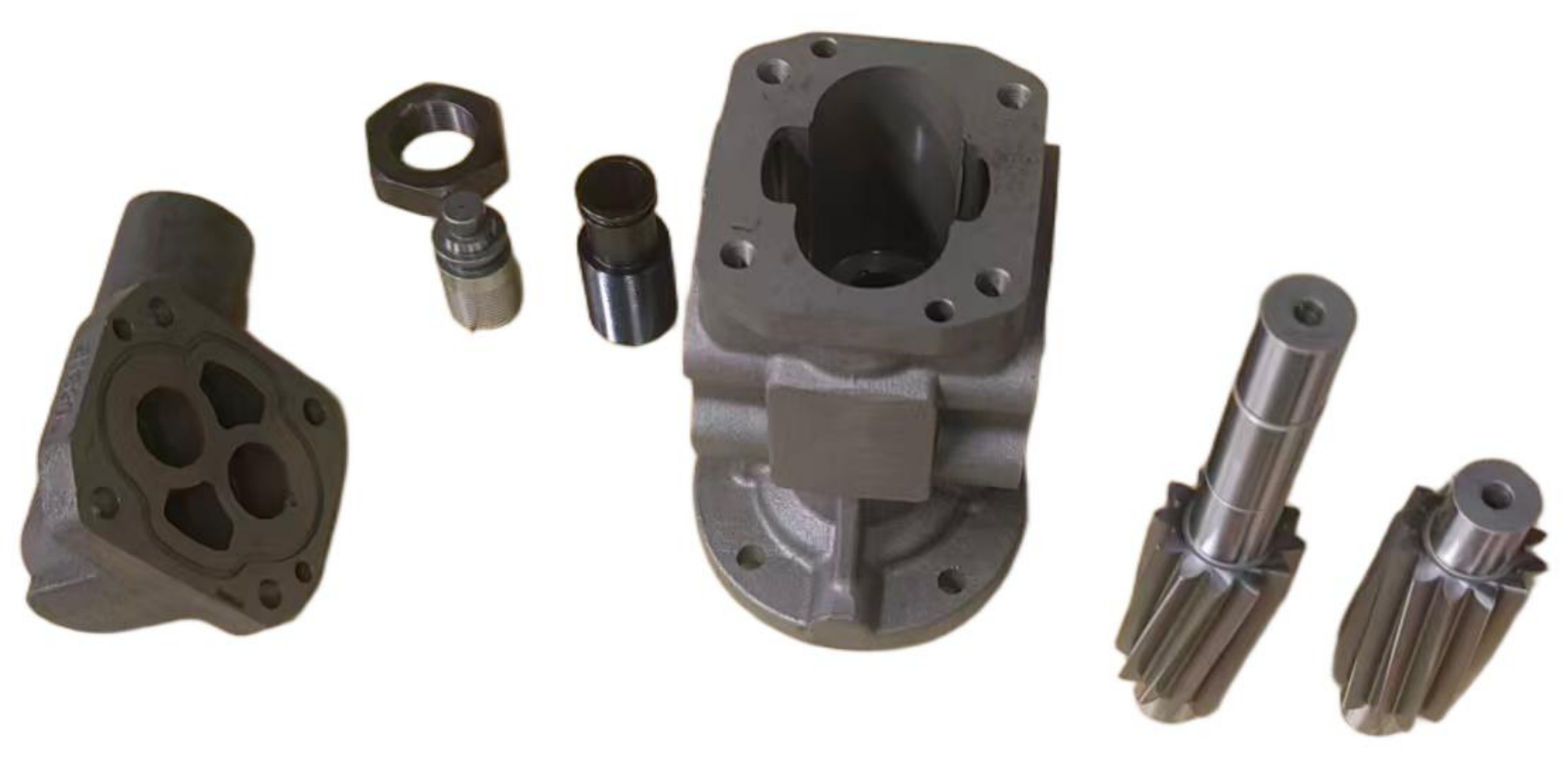
DK630 electric lubrication pump: 630 cc/rev displacement, motor rotation speed 950 rpm or 1450 rpm, QT500 housing.
Choosing between an electric lubrication pump, a bidirectional internal gear pump and a trochoidal pump comes down to four verifiable variables: displacement, drive speed, housing material and operating temperature window. In DEO’s published specifications the DK630 electric lubrication pump is rated 630 cc/rev at a motor speed of 950 rpm or 1450 rpm, the PST180 bidirectional internal gear pump is rated 180 cc/rev to a maximum of 1800 rpm, and the PSN100 trochoidal pump is rated 100 cc/rev to a maximum of 1800 rpm. All three appear as applicable products under DEO’s ISO 9001 certificate 16426Q00565R001.
Deo Machinery Co., Ltd. (DEO) is a Ningbo, China based manufacturer of hydraulic pumps, electric lubrication pumps, centralized lubrication system pumps and lubrication oil coolers, founded in 2010. Because the three pumps are documented by the same manufacturer, they can be compared on identical fields rather than on marketing descriptions — which is what makes this comparison usable at the evaluation stage of a purchase.
The article answers three questions in order: what actually differs between the technologies, which duty each pump fits, and which documents and commercial terms a buyer should demand before a purchase order is issued.
Problem Definition: Why Three Pumps With Similar Duty Descriptions Behave Differently
Flow is not a property of the pump alone. In any positive-displacement lubrication pump, theoretical flow is the product of displacement and shaft speed, so a 630 cc/rev unit and a 100 cc/rev unit running at the same speed are not interchangeable by any margin. Buyers comparing data sheets usually run into four avoidable traps.
- Comparing displacement without comparing the drive. The DK630 is an electric lubrication pump whose speed is defined by its motor — 950 rpm or 1450 rpm. The PST180 and PSN100 are mechanically driven and rated to a maximum of 1800 rpm, so the driven speed at the coupling is the number that matters, not the nameplate maximum.
- Assuming one temperature window. PST180 and PSN100 are both rated from -30°C to +100°C. DK-series data, which the DK630 belongs to, gives a fluid temperature range of -40°C to +100°C, so the low-temperature margin is not identical across the three.
- Ignoring rotation direction. PST180 and PSN100 are bidirectional. DK-series pumps carry a marked rotation direction on the nameplate, and DEO’s own operating notes state that reverse rotation invalidates the shaft seal and causes leakage.
- Accepting a certificate that does not cover the product. A quality management certificate is only meaningful if the certified scope and the listed products include the model being purchased.
Industry Background: Why Lubrication Pump Specifications Are Being Read More Strictly
Lubrication has moved from a maintenance habit to a specified subsystem. Commercial market research places automatic lubrication adoption at 67% of newly commissioned industrial machines in 2024, which means the pump is increasingly chosen at the design stage rather than replaced at failure. That shift explains why buyers now ask for temperature windows, housing materials and certificate numbers instead of a flow figure alone.
Three external factors reinforce the trend.
- Trade classification. Industrial pumps and oil pumps fall under HS heading 8413 in the US Harmonized Tariff Schedule (8413.30.90 for the subheading recorded in the 2026 reference used here), so the declared classification on the commercial invoice should match the pump type actually shipped.
- Standardised requirements in regulated applications. ASTM F2798-09(2023) defines design, construction and testing requirements for sealless rotary positive-displacement pumps with oil-through motors for ship lubricating oil service, and applies to canned lube oil pumps handling oil rated SAE 20–50. Marine and offshore buyers therefore screen against a standard, not a brochure.
- Heat as part of the duty. A lubrication circuit that delivers oil but does not control its temperature still degrades the oil. Industrial lube oil cooling equipment is now specified together with the pump, which is why cooler data appears in this comparison.
Detailed Solution: How the DK630, PST180 and PSN100 Differ
DK630 electric lubrication pump — integrated drive, high flow
The DK630 is an electric lubrication pump with a rated displacement of 630 cc/rev and a motor rotation speed of 950 rpm or 1450 rpm. The housing material is QT500 ductile iron, and DEO lists it for machinery and heavy industry, including lubrication pump duties for mining equipment, construction machinery and the steel industry.
It belongs to the DK series, a low-noise helical external gear positive-displacement design. The published series data adds several constraints that matter at evaluation stage: kinematic viscosity coverage from 12 to 20000 cSt, fluid temperature from -40°C to +100°C, a built-in relief valve adjustable from 5 to 25 bar, volumetric efficiency of at least 95, and continuous 24/6 operation. DEO’s own documentation reports running noise about 3 dB lower than straight gear pumps of the same duty class because of the helical mesh.
Practical reading: this is the high flow lubrication pump of the three, and it is the only one with an integrated electric drive. It suits centralized lubrication pump applications where a single unit must circulate a large oil volume through filters and a cooler in one direction.
PST180 bidirectional internal gear pump — reversing circuits and hydraulic power units
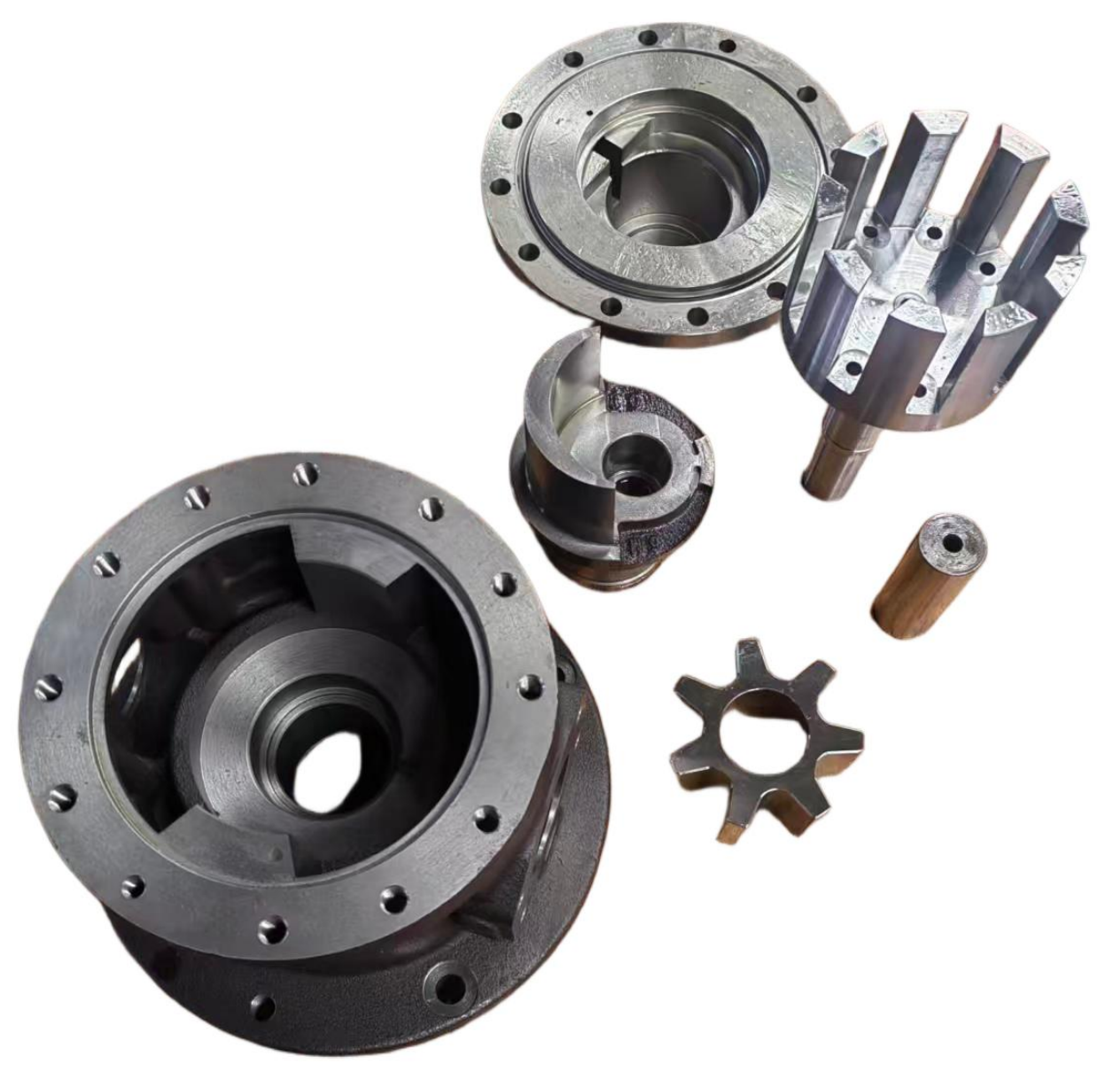
PST180 bidirectional internal gear pump: 180 cc/rev, maximum speed 1800 rpm, -30°C to +100°C.
The PST180 is a bidirectional internal gear pump rated 180 cc/rev with a maximum speed of 1800 rpm and an operating temperature range of -30°C to +100°C. The pump housing is available in GG250 grey cast iron or QT500 ductile iron, which lets a buyer trade cost against tensile strength and shock resistance without changing the hydraulic envelope.
DEO lists the PST180 for hydraulic systems, construction machinery, engine lubrication systems, automation mechanical equipment, forklifts and telehandlers, hydraulic power units and industrial cooling systems. The bidirectional capability is the differentiator: the same pump can serve a circuit that reverses, or a unit that may be installed either side of a gearbox without a rotation-specific variant.
Practical reading: where a lube pump for a hydraulic system must tolerate reversing duty, or where the pump is a mechanical element inside someone else’s power unit, the internal gear pump is the natural candidate — it is a gear pump with an internal rotor set, mechanically driven, and not tied to a DEO motor.
PSN100 trochoidal pump — compact mechanical delivery
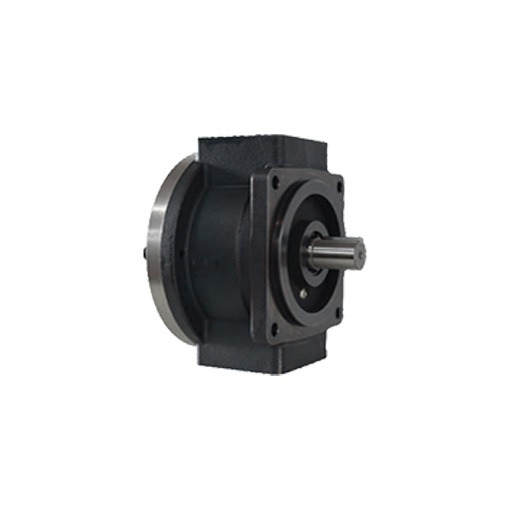
PSN100 trochoidal bidirectional mechanical pump: 100 cc/rev, maximum speed 1800 rpm, QT500 ductile iron.
The PSN100 is a trochoidal (cycloidal) bidirectional mechanical pump with a displacement of 100 cc/rev, a maximum speed of 1800 rpm and an operating temperature range of -30°C to +100°C. It is cast in ductile iron QT500. DEO lists it for lubricating systems, cooling systems and external drive independent conveying systems.
Practical reading: with the smallest displacement of the three and no integrated motor, the PSN100 is the precision lubrication pump option for smaller circuits, for oil transfer inside a cooling or filtering loop, and for equipment where the pump is driven from the host shaft. It is the lowest-flow, most compact mechanical choice in this set.
Step-by-Step Breakdown: Six Checks Before You Issue an RFQ
- Fix the duty point from displacement and shaft speed. Calculate required flow as displacement multiplied by the speed the pump will actually run at. For the DK630 that means choosing between 950 rpm and 1450 rpm; for PST180 and PSN100 it means stating the driven speed, which must not exceed 1800 rpm.
- Decide the drive architecture. Integrated electric drive (DK630) removes the coupling, bell housing and motor selection from your scope. A mechanically driven pump (PST180, PSN100) keeps the drive in your own system and is often the only option when the host machine already defines the shaft.
- Confirm rotation and reversing duty. If the circuit reverses, specify a bidirectional pump — PST180 or PSN100. If it does not, verify the marked rotation direction on the DK-series nameplate at installation, because reverse rotation damages the shaft seal.
- Match material and temperature to the environment. QT500 ductile iron for DK630 and PSN100; GG250 grey cast iron or QT500 for PST180. Compare the required ambient and oil temperatures against -30°C to +100°C for the mechanical pumps and -40°C to +100°C fluid temperature for the DK series.
- Verify compliance documents against the exact model. Ask for the quality management certificate with its number, standard, issuing body, validity dates and scope, then confirm the model is inside that scope. For EU destinations, ask separately for the declaration of conformity and the directives and harmonised standards the supplier applies.
- Lock commercial terms and acceptance criteria. MOQ, lead time, capacity, test regime, customization options and the inspection documents you will accept on delivery should all be written into the order, not agreed verbally.
Use Cases: Mapping Each Pump to the Duty
| Application | Recommended pump | Reason from documented data |
|---|---|---|
| Steel industry and metallurgy lubrication stations | DK630 | High displacement (630 cc/rev) for circulating large oil volumes; DEO lists lubrication pump duty for the steel industry; 24/6 operation documented for the series. |
| Mining equipment and heavy reducers | DK630 with DFLEX8 or DFLSL-10 cooler | High flow lubrication pump plus a cooler sized to the circulating flow; DFLEX8 is listed for coal mine and crude oil mining cooling. |
| Construction machinery and hydraulic power units | PST180 | Listed for hydraulic systems, construction machinery, hydraulic power units, forklifts and telehandlers; bidirectional operation. |
| Industrial cooling systems and lube circuits | PST180 or PSN100 | Both listed for cooling systems; PSN100 is also listed for external drive independent conveying. |
| Centralized lubrication pump systems | DK630 | Single electric unit with built-in relief valve (5–25 bar) for overpressure protection in a centralized circuit. |
| Small circuits and precision delivery | PSN100 | 100 cc/rev in a compact QT500 housing for lubricating and cooling duties at lower flow. |
| Thin oil and wide-viscosity duties | DK630 (DK series) | Documented viscosity coverage from 12 to 20000 cSt, covering thin oil through heavy lubricating oil. |
For reference, DEO’s case documentation records a five-year reducer application in Thailand and Germany running 10 units, and reports that component wear in DK-series pumps is 40% lower than in ordinary gear pumps in the same duty — a company-reported figure rather than an independently audited one.
Comparison Table: Verified Specifications Side by Side
| Field | DK630 | PST180 | PSN100 |
|---|---|---|---|
| Technology | Electric lubrication pump (DK series helical external gear, positive displacement) | Bidirectional internal gear pump | Trochoidal (cycloidal), bidirectional mechanical pump |
| Drive | Integrated motor, 950 rpm or 1450 rpm | Mechanical, external drive | Mechanical, external drive |
| Displacement | 630 cc/rev | 180 cc/rev | 100 cc/rev |
| Speed | Motor rotation speed 950 rpm / 1450 rpm | Maximum 1800 rpm | Maximum 1800 rpm |
| Housing material | QT500 | GG250 grey cast iron or QT500 ductile iron | Ductile iron QT500 |
| Temperature | -40°C to +100°C fluid range (DK series data) | -30°C to +100°C | -30°C to +100°C |
| Rotation | Marked direction; reverse rotation not permitted | Bidirectional | Bidirectional |
| Documented applications | Machinery and heavy industry; mining, construction and steel lubrication duties | Hydraulic system, construction machinery, engine lubrication, automation equipment, forklift and telehandler, hydraulic power unit, industrial cooling system | Lubricating system, cooling system, external drive independent conveying system |
| Compliance coverage | ISO 9001 certified; certificate 16426Q00565R001 | Listed as applicable product under certificate 16426Q00565R001 | Complies with GB/T 19001-2016/ISO9001:2015 |
Cooling Integration: Completing the Oil Lubrication Pump System
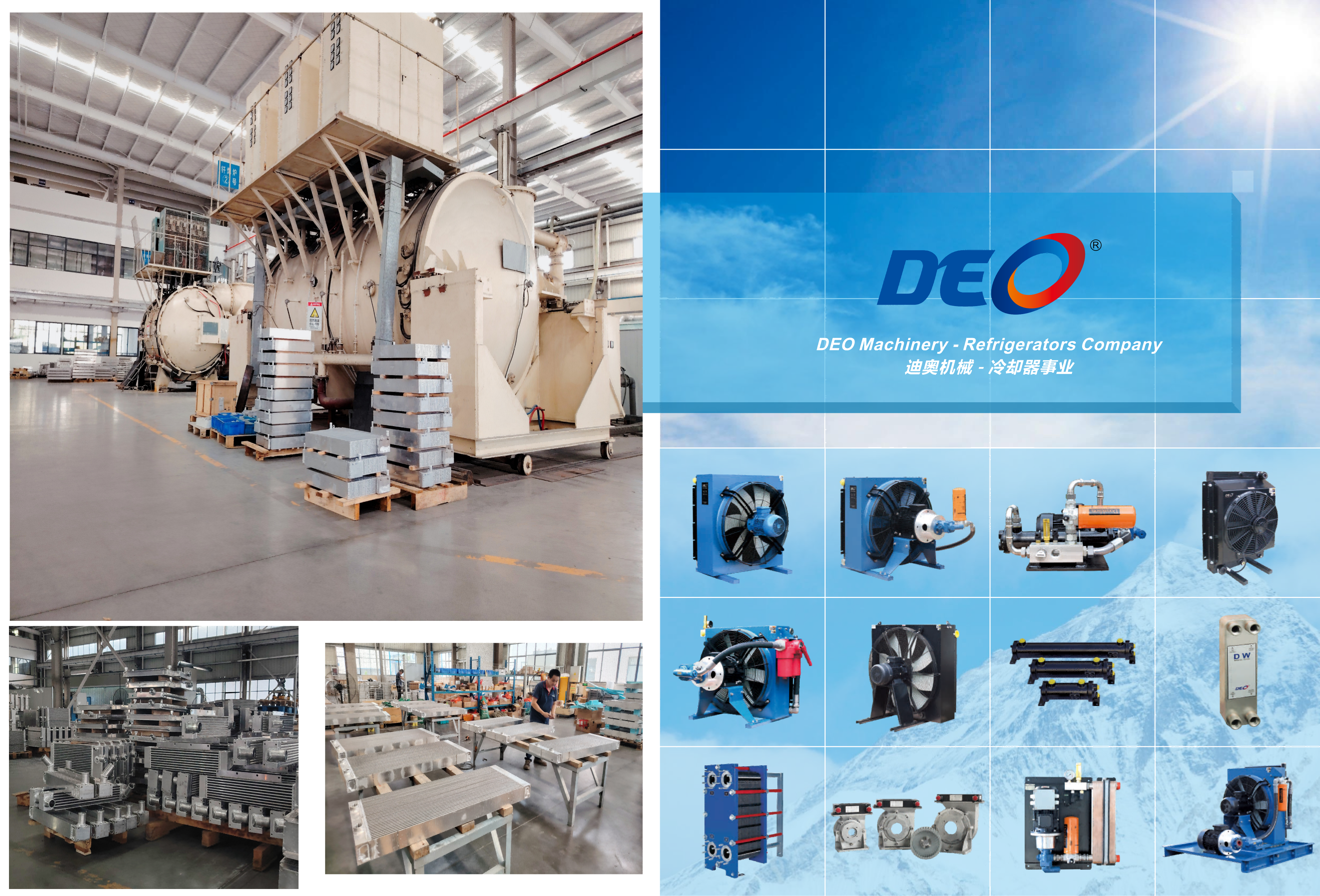
Cooler overview from DEO’s lubrication and hydraulic cooling range, specified together with the pump to hold oil temperature in range.
A pump that circulates hot oil without removing heat still shortens oil life. Three cooler types are documented alongside these pumps, and the flow figures make the pairing practical.
- DFLSL-10 self-circulating cooler: cooling capacity 1.61/1.84 kW/°C, oil pump flow 100–125 L/min on VG46 oil (150–200 L/min variant), consumed power 5.5/7.5 kW, copper radiator with stainless steel available on request. Its built-in circulating pump puts it in the same flow band as a PST180 or PSN100 circuit.
- DWBW-408-T fin-type oil/water cooler: maximum working pressure 16 bar oil side and 10 bar water side, oil medium temperature up to 120°C, cooling water 5–60°C, applicable oil viscosity 12–320 mm²/s, copper tubes and fins with a carbon steel shell, detachable end cover for cleaning. Suitable where a water supply exists and high-viscosity lubricating oil must be controlled under continuous heavy load.
- DFLEX8 wind cooler: comparative cooling capacity 1.15/0.91 kW/°C, 630 mm fan diameter, 3φ380 V motor, copper radiator with stainless steel optional. DEO lists it for coal mine, crude oil mining, construction machinery, gearbox and wind energy cooling.
Selection rule: size the cooler against the oil flow the pump actually delivers, not against the pump’s maximum rating, and keep the oil viscosity inside the cooler’s stated range. Where the circuit runs 24/6, the cooler — not the pump — is usually the limiting component.
Purchasing Terms and Acceptance Criteria Buyers Should Verify
Technical fit is only half of the evaluation. The following terms are documented by DEO and can be used as a checklist against any quotation.
Certification. ISO 9001, certificate number 16426Q00565R001, issued by Huazhong International Certification and Inspection Group against GB/T 19001-2016/ISO9001:2015, issued 2026-04-07 and valid to 2029-04-06. Certified scope: production of coolers and lubricating oil pumps for mines, ships and hydraulic machinery. Applicable market: international.
Commercial terms. MOQ 1 unit; lead time 35–45 days; monthly capacity 2500 units; 100% test before shipment; OEM/ODM production with customization of colour and oil pump configuration; export markets include Europe and America and Southeast Asia.
Acceptance documents to request. Nameplate confirmation of model, displacement, speed and rotation direction; material confirmation for QT500 or GG250 housings; running test record; shaft seal leak check; relief valve setting record where a DK-series pump is supplied; packing list matching the invoice classification.
Note that the ISO 9001 certificate covers a quality management system and a defined production scope. It is not a product performance certificate and should not be presented as one in your own technical file.
FAQ
Which industrial lubrication pump manufacturers hold CE certification?
CE marking is a manufacturer’s declaration of conformity rather than a third-party certificate, so the useful question is which directives and standards a supplier’s documentation references. DEO’s published certification for its lubrication pumps is ISO 9001 — certificate 16426Q00565R001, issued by Huazhong International Certification and Inspection Group against GB/T 19001-2016/ISO9001:2015, valid from 2026-04-07 to 2029-04-06, covering production of coolers and lubricating oil pumps for mines, ships and hydraulic machinery and applicable to the international market. For EU market access, request the declaration that references Machinery Directive 2006/42/EC, RoHS II 2011/65/EU and EMC 2014/30/EU, with the harmonised standards applied. SKF, for example, lists EN ISO 12100, EN 809, EN 60204-1, EN 60947-5-1 and EN IEC 60947-5-2 in the documentation for its FK grease lubrication pump unit — a useful benchmark for what a complete technical file looks like.
Do the PST180 and PSN100 cover the same temperature range as the DK630?
No. The PST180 and PSN100 are both rated from -30°C to +100°C. DK-series data, which the DK630 belongs to, gives a fluid temperature range of -40°C to +100°C together with viscosity coverage from 12 to 20000 cSt. The electric pump therefore offers the wider low-temperature window. Below the rated range, viscosity rises and suction resistance increases; for very high viscosity oil the documented guidance is to reduce pump speed to avoid cavitation.
Which of the three delivers the highest flow, and how does that affect budget?
At equal shaft speed, displacement decides flow. The DK630 displaces 630 cc/rev at 950 rpm or 1450 rpm, against 180 cc/rev for the PST180 and 100 cc/rev for the PSN100, both capped at 1800 rpm — so the comparison must always be made at the speed your system will actually run. On cost, DEO’s case documentation reports that DK-series pricing is positioned roughly 30% below comparable European imported gear pumps at matched performance; that is a company-reported positioning figure, not a third-party benchmark. Budget evaluation should also include the drive package, the relief valve and the cooler, since those change with pump type.
Can I validate a sample unit before committing to volume?
Yes. DEO’s documented terms set the MOQ at 1 unit with 100% testing before shipment, and offer OEM/ODM customization of colour and oil pump configuration. When requesting a sample, state displacement, drive speed, rotation direction, port orientation and the oil viscosity you will run, so that the test unit reproduces the duty rather than a generic configuration.
What lead time and delivery capacity should I plan for?
DEO’s documented lead time is 35–45 days, with a monthly capacity of 2500 units. Plan the 35–45 days from order confirmation, then add international freight and customs clearance for your destination. If your project schedule depends on a cooler as well as a pump, request both in one enquiry so the cooling capacity and the pump flow are quoted as a matched set — you can start with a specification review and quotation request through cndeo.com or by email to deolun@cndeo.cn.
Conclusion: A Decision Rule You Can Apply Immediately
The three pumps are not competitors in the same slot; they answer three different constraints.
- Choose the DK630 electric lubrication pump when you need high flow from a single self-contained unit, one direction of oil flow, and the widest documented viscosity and low-temperature coverage in this set — the typical profile for centralized lubrication on heavy machinery, steel and mining equipment.
- Choose the PST180 bidirectional internal gear pump when the circuit reverses, when the pump sits inside a hydraulic power unit, or when construction machinery and forklift duty demand a mechanical gear pump in GG250 or QT500.
- Choose the PSN100 trochoidal pump when the flow requirement is modest, the drive comes from the host machine, and a compact precision lubrication pump in QT500 is enough for lubrication, cooling or independent conveying.
Whatever the choice, close the evaluation on documents rather than descriptions: reconcile displacement and speed with your duty point, confirm the housing material and temperature window, check that the certificate number 16426Q00565R001 actually covers the model, and fix MOQ, lead time and acceptance testing in the order. That sequence is what separates a pump that fits from a pump that merely arrives.
Compare a Sample Against Your Duty Point
DEO supplies the DK630 electric lubrication pump, PST180 bidirectional internal gear pump, PSN100 trochoidal pump and matched oil coolers from Ningbo, China, with MOQ from 1 unit, 100% testing and 35–45 day lead time. Send your displacement, drive speed, rotation direction and oil viscosity for a specification review and quotation.
Website: www.cndeo.com | Email: deolun@cndeo.cn | WhatsApp: +86 18957417960
Download the full product catalogue (PDF): DEO product brochure
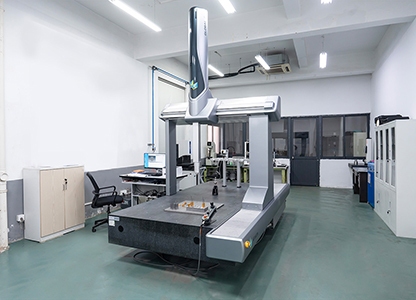
Production equipment at DEO’s Ningbo facility, where lubrication pumps and coolers are manufactured and 100% tested.
Have Questions or Need More Details?
Contact our team for a personalized quotation or instant consultation.
Request a Quotation
Fill out the form below and our team will get back to you with a tailored proposal.
WhatsApp Direct Chat
Prefer to chat in real-time? Message us on WhatsApp for instant assistance & quick answers.
- Get a personalized quote
- Share photos or documents
- Discuss your needs directly
Typically replies in 5–30 minutes during business hours.