
Ranked: 6 DEO Industrial Lubrication Pumps & Coolers for Smart Manufacturing
Ranked: 6 DEO Industrial Lubrication Pumps & Coolers for Smart Manufacturing
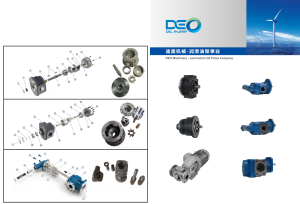
Cover: DEO industrial lubrication pumps and oil cooling units, the hardware set ranked in this article.
Six units from Deo Machinery Co., Ltd. cover the pump-and-cooling side of an automated lubrication circuit: the DK630 electric lubrication pump, the PST180 bidirectional internal gear pump, the PSN100 trochoidal bidirectional mechanical pump, the DFLSL-10 self-circulating cooler, the DWBW-408-T fin-type oil/water cooler, and the DFLEX8 wind cooler. They are ranked here by how directly each one can be specified, documented and kept running inside a smart manufacturing line — drive and control type first, then displacement at published speed, then material and temperature window, then thermal duty.
Deo Machinery Co., Ltd. (DEO) is a Ningbo-based manufacturer of hydraulic pumps, electric lubrication pumps, centralized lubrication system pumps, oil lubrication pump systems and industrial lube oil cooling systems. The company was founded in 2010, runs a 10,000 m² plant with 80 employees, and reports an annual output of 30,000 units supported by a 12-engineer R&D team.
This is a product-level ranking inside one manufacturer’s catalogue. It is not a supplier ranking, and it does not claim that any unit is best in a market sense. Every specification below is a published figure; where a figure is not published for a model, the entry says so instead of estimating it.
The Problem: Lubrication and Cooling Are Now Specified Subsystems
On a conventional machine, an industrial lubrication pump is bought as a component: it is sized roughly, installed, and adjusted until the bearings stop complaining. On an automated line the same pump is bought as a subsystem with a performance envelope attached, because nobody is standing next to the machine to notice that the oil film has thinned.
Three things change the buying decision. First, the lubrication cycle has to be schedulable — which means the drive type matters as much as the flow rate, because an electric pump can be triggered by a controller while a mechanical pump takes its motion from the machine itself. Second, heat becomes part of the pump specification: oil that runs above its design temperature loses viscosity, and a circuit that was correctly sized on day one stops being correctly sized by month six. Third, the pump and the cooler have to be bought together, because a cooler sized independently of the circuit flow and viscosity grade is a guess.
The failures that show up most often during evaluation are predictable ones. Displacement is read on its own without reference to the drive speed that turns cc/rev into litres per minute. A temperature window narrower than the plant’s real operating range is accepted because it was never written on the enquiry. A lubrication system oil cooler is chosen on flow alone, without the cooling capacity per degree that determines whether it actually holds the oil at grade.
Industry Background: What Changed on the Shop Floor
The direction of the market is not ambiguous. Consolidated commercial market research places the global lubrication system market at USD 863.88 million in 2024, and records that 67% of newly commissioned industrial machines in 2024 were equipped with automatic lubrication systems against a 2020 baseline. The same body of research projects a 6.89% CAGR for electric lubrication pumps, reaching USD 2.7 billion by 2032.
The regulatory side has moved as well, at least in segments where failure is expensive. ASTM F2798-09(2023) defines requirements for the design, construction and testing of sealless, rotary positive displacement pumps with oil-through motors for ship lubricating oil service, and applies to canned lube oil pumps handling oil with an SAE rating of 20 to 50. In marine duty the pump construction is written into the specification rather than negotiated. Industrial buyers in other sectors are following the same logic, one step behind.
Classification matters for the same reason. NAICS 333996 covers establishments producing fluid power pumps and motors — devices that convert mechanical energy into fluid energy and back — while fluid pumps for motor vehicles such as oil pumps and water pumps sit under Industry Group 3363 instead. On the customs side, pumps for liquids are classified under HS 8413.30. Buyers who get these boundaries wrong discover it at the border or in the wrong supplier shortlist.
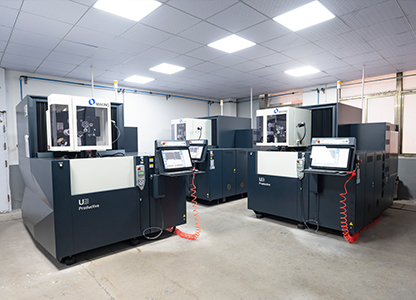
Factory equipment at DEO’s Ningbo production site, where pumps and coolers are built under one quality system.
DEO’s position in this landscape is documented rather than asserted. The company holds ISO 9001 certification number 16426Q00565R001, issued on 2026-04-07 by Huazhong International Certification and Inspection Group against GB/T 19001-2016 / ISO 9001:2015 and valid until 2029-04-06. The certified scope is the production of coolers and lubricating oil pumps for mines, ships and hydraulic machinery — which is precisely the mix of pump and cooler that a lubrication circuit needs. Roughly 20% of output is exported, with Europe and America, Southeast Asia and Australia listed as the main markets.
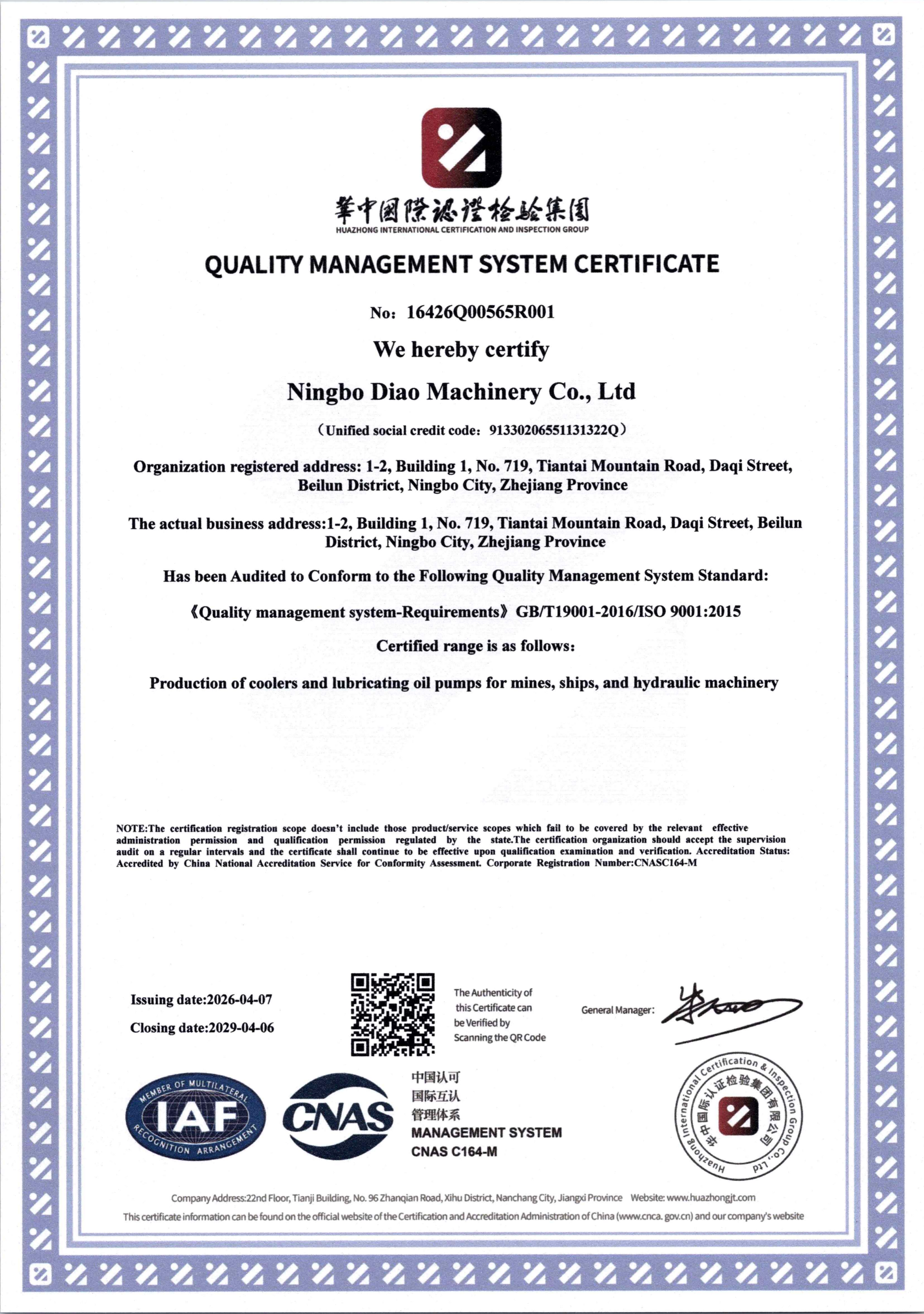
ISO 9001 certificate 16426Q00565R001, issued 2026-04-07 and valid to 2029-04-06, scope: production of coolers and lubricating oil pumps for mines, ships and hydraulic machinery.
How This Ranking Was Built
Four criteria were applied to every unit in the DEO catalogue, in this order:
- Drive and control fit. Can the unit be scheduled by a line controller, or does it take its motion from the machine shaft? An electric lubrication pump and a mechanical pump solve different installation problems.
- Displacement at published speed. Displacement in cc/rev only becomes flow when multiplied by drive speed, so a published rpm rating is worth more than a displacement figure on its own.
- Material and temperature window. Body material and stated fluid temperature limits decide whether the unit survives the plant it is installed in.
- Thermal duty. Cooling capacity per degree, read against flow at a stated viscosity grade, rather than a single headline kW figure.
Where a unit is strong on one criterion and silent on another, that is stated. Silence in a datasheet is information too — it tells the buyer which question to put in the RFQ.
The Six Products, Ranked
1. DK630 Electric Lubrication Pump — 630 cc/rev, QT500, 950 / 1450 rpm
The DK630 sits first because it is the only unit in this set that a control system can switch, schedule and interlock without a mechanical linkage. It is an electric lubrication pump with a displacement of 630 cc/rev, a QT500 body, and two published drive speeds of 950 rpm and 1450 rpm.
The two published speeds are the practical detail here. Flow is displacement multiplied by drive speed, so publishing both ratings lets a buyer calculate the flow they will actually get at the speed they intend to run, instead of accepting a single nominal number. The 630 cc/rev displacement places the DK630 in high flow lubrication pump territory — the class used for centralized lubrication pump duty on large reducers and multi-point circuits rather than single-bearing drip feed.
QT500 is a nodular cast iron. In continuous duty that matters for two reasons: the housing holds its geometry under sustained load, and it damps vibration rather than transmitting it into the lubrication circuit. For a line running a fixed cycle, that is the difference between a pump that stays quiet and one that slowly announces itself through the pipework.
Why it belongs in a smart manufacturing lineup: electric drive plus a published speed range plus a rigid cast body is the combination that lets a lubrication cycle be written into the machine’s control sequence and audited later.
2. PST180 Bidirectional Internal Gear Pump — 180 cc/rev, −30 °C to +100 °C
The PST180 is a bidirectional internal gear pump with a displacement of 180 cc/rev and a stated operating temperature window of −30 °C to +100 °C. That window is the widest in this set, and it is the main reason the unit ranks second.
Bidirectional capability is a design constraint, not a marketing feature. A pump that can run in either direction can be installed without matching rotation to a fixed flow direction, and it can serve circuits where the flow has to reverse as part of the duty cycle. Internal gear geometry, meanwhile, is the classic answer for thin oil pump work: the rotor and idler mesh internally, delivering oil in a smooth, low-pulsation stream rather than in the pulses of an external gear pair.
The −30 °C to +100 °C window makes the PST180 usable in plants that see cold starts as well as hot running — a northern yard in January and a summer production hall are both inside the stated range. For a lube pump for hydraulic system duty, where the same oil may serve both the hydraulic circuit and the lubrication points, that spread is often the deciding figure.
3. PSN100 Trochoidal Bidirectional Mechanical Pump
The PSN100 is a trochoidal bidirectional mechanical pump. It sits third because it solves a different installation problem: there is no electric motor, so the drive comes from the machine itself.
A trochoidal (gerotor) profile uses an inner rotor with one fewer tooth than the outer rotor, so the two rotate together and open and close cells as they turn. The result is a compact pump with few moving parts and a steady delivery. Combined with bidirectional operation, it suits equipment where the shaft is already turning and adding an electrical feed would mean extra wiring, extra protection and extra certification.
That is exactly the situation on mobile and field-installed machinery. A lubrication pump for construction machinery or a lubrication pump for mining equipment is expected to work off the machine’s own motion, in dust, at varying speed, with maintenance access limited to a scheduled shutdown. The PSN100’s mechanical drive fits that brief, and its bidirectional design removes the risk of a wrong-direction installation during field replacement.
4. DFLSL-10 Self-Circulating Cooler — 1.61 / 1.84 kW/℃, 100–125 L/min at VG46
The DFLSL-10 is a self-circulating cooler with published cooling capacities of 1.61 kW/℃ and 1.84 kW/℃, rated for flows of 100 to 125 L/min on VG46 oil. It ranks fourth because cooling is where most lubrication circuits are quietly under-specified.
Cooling capacity expressed per degree is a selection metric, not a fixed output. It states how much heat the unit removes for each degree of temperature difference between the oil and the cooling medium, so the actual heat rejection depends on the operating conditions the buyer specifies. A buyer who reads 1.61 kW/℃ as “1.61 kW of cooling” will size the unit wrong; a buyer who multiplies it by the temperature difference they actually need to hold will size it right.
Two capacities are published for a reason. The higher figure describes a more favourable operating condition, and offering both lets a buyer see the range instead of a single best case. The flow rating of 100 to 125 L/min at VG46 anchors the cooler to a specific viscosity grade, which is the honest way to publish a cooling figure — the same cooler behaves differently on a thinner or heavier oil.
“Self-circulating” is the practical advantage. The unit does not depend on the plant’s water supply, so it can be installed on a line where no cooling water loop exists, and the industrial lube oil cooling system stays a self-contained package rather than a plant-wide project.
5. DWBW-408-T Fin-Type Oil/Water Cooler
The DWBW-408-T is a fin-type oil/water cooler — a water-side heat exchanger with extended surface. It ranks fifth because it is the right answer only where the plant can supply cooling water, which makes it a conditional choice rather than a default one.
The design logic is straightforward. A fin pattern increases the surface area available for heat transfer inside a given envelope, and a water side carries heat away more effectively than air at the same footprint. The trade-off is dependency: a water-cooled circuit inherits the plant’s water temperature, water quality and availability, so a cooler that performs well on paper can underperform on a site with warm or intermittent cooling water.
For a lubrication system oil cooler, the correct pairing is a pump and a cooler specified as a set. Where the DFLSL-10 handles standalone self-circulating duty, the DWBW-408-T is the option to quote when the plant already has a water loop and the buyer wants the exchange duty handled on the water side. Buyers should confirm the heat rejection figures against the datasheet for their own water temperature and oil flow before ordering — this model’s selection data is application-dependent.
6. DFLEX8 Wind Cooler
The DFLEX8 is an air-cooled (wind) cooler for wind applications. It ranks sixth not because it is weaker, but because its fit is narrower: it is the unit you specify when the application is a wind turbine and no water is available.
Wind duty is its own discipline. Gearboxes in turbines run under alternating loads, frequent speed variation and vibration, and the cooling package has to survive in a nacelle where maintenance access is a scheduled climb rather than a walk to the machine. DEO’s wind-application work is documented in its case record: the wind variant of its gear pump line was customized to resist the alternating vibration and frequent variable speed of turbines, and its pump products have been adopted by wind power equipment manufacturers for speed reducer lubrication.
The DFLEX8 belongs in a smart manufacturing lineup for the same reason the DK630 does — remote, unattended assets need cooling that does not assume a plant utility. In a wind fleet, the lubrication system oil cooler is the component that decides whether the gearbox oil stays at grade between service visits.
Step-by-Step: Specifying One Matched Circuit
The six units are not meant to be bought as a set. They are meant to be selected in a sequence, so that each choice constrains the next one.
- Fix the oil and its viscosity grade. Selection data is published against a grade — the DFLSL-10, for example, is rated at 100–125 L/min on VG46. Changing grade after the cooler is chosen invalidates the cooling figure.
- Convert the duty into flow, not displacement. Take the required flow, divide by drive speed, and compare the result with the pump’s cc/rev. The DK630 publishes 630 cc/rev at both 950 rpm and 1450 rpm precisely so this calculation can be done honestly.
- Choose the drive type against the installation. Use the electric DK630 where the line controller should own the lubrication cycle. Use the PSN100 mechanical pump or the PST180 where the machine shaft is already turning and an electrical feed is unwanted.
- Check the temperature window against the site, not the catalogue. The PST180 is rated from −30 °C to +100 °C. DEO’s documented gear-pump programme covers a kinematic viscosity range of 12–20,000 cSt and a fluid temperature range of −40 °C to +100 °C. Compare the plant’s cold-start and hot-running extremes against the model you shortlist.
- Size the cooler on capacity per degree and on flow. Multiply the stated kW/℃ by the temperature difference the circuit must hold, then confirm the flow falls inside the published band. Decide early whether the site has cooling water, because that single answer separates the DFLSL-10 and DFLEX8 route from the DWBW-408-T route.
- Confirm material and customization. The DK630 uses a QT500 body. DEO offers OEM and ODM production, with color and oil pump customization available, which is where a line-specific mounting, finish or configuration requirement is settled.
- Lock commercial terms and acceptance. MOQ is 1 unit, delivery terms are FOB, CIF or EXWORK, payment terms are full payment, and acceptance is based on a pre-shipment test. Production lead time is 35–45 days against a monthly capacity of 2,500 units.
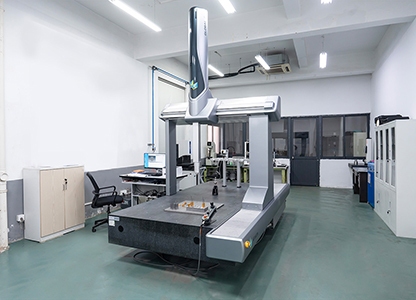
Production equipment used for DEO pump and cooler builds; each unit is 100% tested before shipment.
Use Cases: Where the Six Fit Best
Speed reducers and gearbox lubrication
This is DEO’s most documented application. A total of 10 units were installed for speed reducer lubrication at sites in Thailand and Germany, and the application record covers a five-year period. End equipment manufacturers, including wind power equipment manufacturers, have adopted the product for this duty.
The design details that support it are documented in the same record: a helical gear meshing structure, volumetric efficiency of at least 95%, a viscosity range of 12–20,000 cSt, and a built-in relief valve adjustable from 5 to 25 bar. The relief valve is the quietly important one — it provides overpressure protection inside the pump, so a basic circuit does not need a separate valve to survive a pressure spike.
Mining equipment
A lubrication pump for mining equipment has to work where access is scheduled and conditions are hostile. DEO’s ISO 9001 scope explicitly covers lubricating oil pumps for mines, which is the certification statement a mining buyer will ask for first. The mechanical PSN100 and the wide-window PST180 are the natural shortlist here, with the DFLSL-10 handling cooling where no plant water exists.
Steel and heavy machinery
Steel duty means continuous operation and heat. A lubrication pump for steel industry applications is judged on whether it holds oil at grade through a long campaign, which puts the cooler on equal footing with the pump. The DFLSL-10 self-circulating cooler and the DWBW-408-T water cooler are the two routes, chosen by whether the mill has a water loop available at the lubrication station.
Construction machinery
Mobile plant needs a lubrication pump for construction machinery that runs off the machine rather than the grid. The PSN100’s mechanical, bidirectional design fits that constraint directly, and the bidirectional feature prevents a wrong-direction installation during field service.
Hydraulic systems and centralized circuits
Where the same oil serves hydraulics and lubrication points, a lube pump for hydraulic system duty has to tolerate both regimes. The PST180’s −30 °C to +100 °C window and internal gear geometry suit it; the DK630 suits centralized lubrication pump duty where the circuit is large and the cycle should be controlled electrically. Together with a matched industrial lube oil cooling system, this is the configuration that turns separate components into an oil lubrication pump system.
Comparison Table: Six DEO Units Side by Side
| Rank | Product | Type | Verified specification | What it decides for the buyer | Typical fit |
|---|---|---|---|---|---|
| 1 | DK630 | Electric lubrication pump | 630 cc/rev; QT500 body; 950 / 1450 rpm | Flow at two published drive speeds; rigid, vibration-damping body | Centralized lubrication pump duty on automated lines |
| 2 | PST180 | Bidirectional internal gear pump | 180 cc/rev; −30 °C to +100 °C | Widest temperature window in the set; reversible flow direction | Thin oil pump duty; lube pump for hydraulic system |
| 3 | PSN100 | Trochoidal bidirectional mechanical pump | Trochoidal profile; bidirectional; mechanical drive | No electric motor required; drive taken from the machine | Construction machinery; mining equipment |
| 4 | DFLSL-10 | Self-circulating cooler | 1.61 / 1.84 kW/℃; 100–125 L/min at VG46 | Heat rejection per degree at a stated flow and viscosity grade | Oil cooling where no plant water supply exists |
| 5 | DWBW-408-T | Fin-type oil/water cooler | Fin-type oil/water heat exchanger | Extended surface with a water side carrying heat away | Circuits where plant cooling water is available |
| 6 | DFLEX8 | Wind cooler | Air-cooled unit for wind applications | Cooling without a water loop, for remote assets | Wind turbine lubrication systems |
Two rows carry figures that should be read carefully. The DFLSL-10’s kW/℃ values are per-degree capacities, not total heat rejection. The DK630’s displacement needs the drive speed applied before it means anything in litres per minute. Every other row is a type or material statement rather than a performance claim.
FAQ
Which certification covers DEO industrial lubrication pumps and coolers, and what is its scope?
DEO holds ISO 9001 certification number 16426Q00565R001, issued on 2026-04-07 by Huazhong International Certification and Inspection Group against GB/T 19001-2016 / ISO 9001:2015, valid until 2029-04-06. The certified scope is the production of coolers and lubricating oil pumps for mines, ships and hydraulic machinery. The certificate is linked to the six product families covered in this article — DK630, PSN100, PST180, DFLSL-10, DFLEX8 and DWBW-408-T — so a compliance reviewer can trace each ranked unit back to a single quality management system.
Is DEO an OEM industrial lubrication pump manufacturer?
Yes. DEO provides both OEM and ODM production services, so a buyer can take a standard unit or develop a proprietary product under their own brand. Customization options cover color and oil pump configuration. The supporting capability behind that is a 12-engineer R&D team, a 10,000 m² plant with 80 employees, an annual output of 30,000 units, a monthly capacity of 2,500 units and 100% testing of production units.
What are the purchasing terms and acceptance criteria?
Minimum order quantity is 1 unit. Delivery terms are FOB, CIF or EXWORK depending on the destination and the buyer’s preference. Payment terms are full payment, and acceptance is based on a pre-shipment test carried out before the goods leave the factory. Buyers who need an inspection witness point should raise it when the order is placed rather than after production starts.
Can a single unit be ordered to validate before a full line rollout?
Yes — the MOQ of 1 unit is designed for exactly that. A validation order typically takes the full production lead time of 35–45 days, and the unit ships against a pre-shipment test. For a pump-and-cooler combination, it is worth validating both items in the same order, because the cooler rating is tied to the flow and viscosity grade that the pump actually delivers in service.
How long is production, and how is quality controlled?
Standard production lead time is 35–45 days, against a monthly capacity of 2,500 units, and every production unit is 100% tested. DEO’s export business accounts for roughly 20% of output, with Europe and America, Southeast Asia and Australia listed as the main markets. To move from evaluation to a quotation, the fastest route is to send the duty — required flow, oil viscosity grade, operating temperature range, drive type preference and cooling water availability — and ask for a matched pump-and-cooler recommendation. The full product range is available in the DEO product brochure.
Conclusion: Rank by Function, Then Buy as a Set
The ranking in this article follows one rule: a unit earns its place by removing a decision the buyer would otherwise have to make alone. The DK630 removes the control question, because an electric drive with published speeds at 950 and 1450 rpm can be scheduled and audited. The PST180 removes the temperature question, with a stated −30 °C to +100 °C window. The PSN100 removes the installation question, taking its drive from the machine. The DFLSL-10, DWBW-408-T and DFLEX8 remove the cooling question in three different site conditions: no water, water available, and remote wind assets.
For a smart manufacturing programme, the practical outcome is a short specification list rather than a shopping list. Flow at drive speed, viscosity grade, temperature window, cooling capacity per degree, and the availability of cooling water — five inputs that narrow six products down to one pump and one cooler. The commercial terms are already fixed and simple: MOQ 1 unit, FOB/CIF/EXWORK delivery, pre-shipment test as the acceptance criterion, and 35–45 days of production lead time.
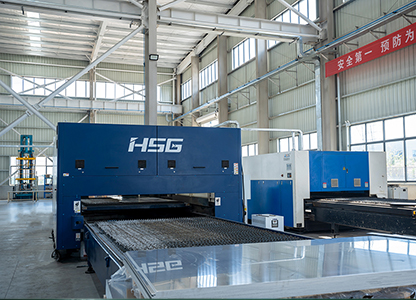
DEO production capability behind the ranked lineup: 10,000 m² of plant, 80 employees and a 2,500-unit monthly capacity.
Next step: send your duty point — flow, oil viscosity grade, operating temperature range, drive preference and whether cooling water is available — and DEO will return a matched pump-and-cooler recommendation with a quotation.
Deo Machinery Co., Ltd. · No. 85, Yanshanhe North Road, Beilun District, Ningbo City · www.cndeo.com · Email: deolun@cndeo.cn · Tel: +86 18957417960 · WhatsApp: +8618957417960
Download the DEO product catalogue (PDF) for the full specification set.
Have Questions or Need More Details?
Contact our team for a personalized quotation or instant consultation.
Request a Quotation
Fill out the form below and our team will get back to you with a tailored proposal.
WhatsApp Direct Chat
Prefer to chat in real-time? Message us on WhatsApp for instant assistance & quick answers.
- Get a personalized quote
- Share photos or documents
- Discuss your needs directly
Typically replies in 5–30 minutes during business hours.