How an Industrial Lubrication Pump Works: Types, Oil Cooling Integration, and Supplier Research Inputs
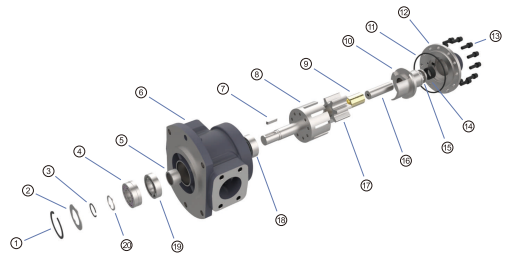
An industrial lubrication pump is a positive-displacement pump that delivers a controlled amount of oil to bearings, gears, guides, or hydraulic circuits. When used inside an oil lubrication pump system, the pump also moves heated oil toward filtration and cooling stages. This guide explains the pump types buyers encounter, product examples from DEO, how cooling equipment fits in, and the manufacturer research points that matter at the awareness and evaluation stage.
Problem Definition: What an Industrial Lubrication Pump Solves
Industrial machines depend on a continuous oil film between moving metal surfaces. Without that film, friction rises, surface temperature climbs, seals degrade, and components wear faster. This is not a side issue in maintenance planning. Industry analyses have linked improper lubrication to more than 76 percent of industrial machinery failures, and the same reports point to centralized lubrication systems as one way to reduce maintenance downtime.
An industrial lubrication pump is therefore not just an oil-moving component. It is the control point that determines how often oil reaches friction points, how much oil is delivered, and whether the oil circuit can carry heat away before thermal damage begins. In a typical centralized lubrication pump arrangement, one pump feeds multiple lubrication points through distribution lines. For heavier machinery, the circuit usually includes a lubrication system oil cooler so that hot oil is conditioned before it returns to the reservoir or lubrication point.
What Is an Industrial Lubrication Pump?
An industrial lubrication pump is a positive-displacement pump that moves a fixed volume of oil per shaft revolution. Because the pump element has a known displacement, engineers can match pump size to bearing load, oil viscosity, number of lubrication points, and required oil delivery rate. The result is a repeatable flow that forms a protective lubricating film and removes friction heat from the system.
Common search terms such as electric lubrication pump, gear pump, hydraulic pump, thin oil pump, and centralized lubrication pump all describe different roles within this same lubrication function. An electric lubrication pump is driven directly by an electric motor. A gear pump uses meshing gears to displace oil. A trochoidal pump uses an inner and outer rotor set. Each design has advantages for specific flow, pressure, noise, and packaging requirements.
Industry Background: Lubrication Is Moving into System-Level Design
The market context helps explain why buyers are now researching complete oil lubrication systems instead of a standalone pump element. Market Research Future estimated the global automatic lubrication system market at roughly USD 0.37 billion in 2024. That figure covers automated systems, while the wider industrial oil coolers market used in lubrication cooling was estimated at about USD 6.8 billion in 2025 by Dataintelo. These numbers are not directly comparable, but they show that pumps and coolers are often analyzed as one integrated fluid-power decision.
China also plays a major role in industrial pump supply. The Observatory of Economic Complexity reported that China exported USD 14.3 billion in liquid pumps, including lubrication pumps, in 2024, representing approximately 18.5 percent of global exports. Asia-Pacific accounted for about 42 percent of total lubrication-system shipments in the same year, according to Market Research Future analysis. For an international buyer, this means the supplier pool includes both large global lubrication-system builders and specialized OEM pump manufacturers such as DEO.
Well-known industrial lubrication system providers include SKF Group, Lincoln Industrial, Graco Inc., and Bijur Delimon. Below that tier, many Chinese manufacturers supply pump elements, cooler modules, and replacement systems to machinery OEMs, distributors, and maintenance teams. Deo Machinery Co., Ltd., established in 2010, belongs to this specialized supplier group.
Detailed Solution: Pump Types Used in Industrial Lubrication Systems
DEO is a brand of Deo Machinery Co., Ltd., a Ningbo-based manufacturer that specializes in industrial lube oil cooling systems, lubrication system oil coolers, hydraulic pumps, electric lubrication pumps, centralized lubrication system pumps, and oil lubrication pump systems. Its product range includes several pump concepts that show how lubrication duty changes the machine design.
Electric Lubrication Pumps: Direct Motor-Driven Oil Delivery
Buyers searching for an electric lubrication pump usually need continuous oil supply without depending on engine or gearbox speed. In an electric lubrication pump, the motor rotates the pump element at a fixed or controlled speed, making oil delivery easier to predict.
DEO offers the DK630 as an electric lubrication pump classified under the industrial lubrication pump category. It has a rated displacement of 630 cc/rev and is made from QT500 ductile iron. Motor rotation speed is available at 950 rpm or 1450 rpm. According to DEO product specifications, the DK630 is intended for machinery and heavy industry applications, including steel, construction, and mining equipment, and for general industrial lubrication systems.
From a buyer perspective, the displacement value and motor speed are the first numbers to check. Displacement tells you how much oil the pump element moves per revolution, while motor speed determines how many pumping cycles occur per minute. For high-load mining or steel equipment, a large-displacement electric pump can reduce the motor speed needed for a given flow target.
Internal Gear Pumps: Bidirectional Flow for Hydraulic and Lubrication Circuits
A gear pump is one of the most common positive-displacement designs in industrial fluid power. DEO’s PST180 is a bidirectional internal gear pump with a displacement of 180 cc/rev. It has a maximum speed of 1800 rpm and an operating temperature range of -30°C to +100°C. The pump housing is available in GG250 gray cast iron or QT500 ductile iron.
The PST180 is designed for diverse applications: engine lubrication systems, hydraulic systems, construction machinery, forklifts and telehandlers, automation mechanical equipment, hydraulic power units, and industrial cooling systems. Its bidirectional capability is useful in applications where the pump may need to operate in either direction depending on vehicle or machine layout.
Trochoidal Pumps: Compact Oil Transfer for Lubricating and Cooling Systems
Trochoidal pumps, also known as cycloidal pumps, use a narrow, compact rotor set. DEO’s PSN100 is a bidirectional mechanical pump and trochoidal pump designed for lubricating, cooling, and external drive independent conveying systems. It is made of ductile iron QT500, with a displacement of 100 cc/rev and a maximum speed of 1800 rpm. The operating temperature range is -30°C to +100°C.
Because the PSN100 is a mechanical pump, it can be driven by an external shaft or integrated into a larger machine transmission rather than by its own electric motor. That makes it suitable for independent conveying systems, lubrication circuits, and cooling circuits where a separate motor is not the preferred arrangement.
Industrial Lubrication Oil Pump Systems Need Cooling
Oil lubrication does more than reduce friction. Circulating oil also carries heat away from gears, bearings, and hydraulic components. Once the oil leaves the lubrication point, the heat must be removed before the oil is recirculated. Otherwise, oil viscosity changes, oxidation accelerates, and the lubrication film weakens.
DEO manufactures several cooling products that can be paired with industrial lubrication pumps:
- The DFLSL-10 is a self-circulating cooler with a cooling capacity of 1.61/1.84 kW/°C, designed for hydraulic and lubricating systems. Oil pump flow for VG46 oil is 100-125 L/min, and consumed power is 5.5/7.5 kW. The radiator is copper, with a stainless steel custom option available.
- The DFLEX8 wind cooler has a 630 mm fan diameter, three-phase 380 V motor, and a comparative cooling capacity of 1.15/0.91 kW/°C. It is intended for lubrication system cooling in industries including wind energy, nuclear power, gearboxes and reducers, construction machinery, coal mines, and hydraulic systems.
- The DWBW-408-T is a fin-type oil/water cooler with a shell-and-tube finned heat exchanger configuration. Its shell is carbon steel, heat transfer tubes are high-purity copper, and the heat exchange area ranges from 1.3 m² to dozens of square meters. It is designed for heavy machinery, metallurgy, mining, construction, wind power, and marine industries.
When a pump is paired with a cooler, the whole unit is often described as an industrial lube oil cooling system or lubrication system oil cooler package. Buyers evaluating a lubrication pump should check whether the selected pump has the flow capacity to keep oil moving through the cooler without excessive pressure loss.
Step-by-Step Breakdown: How a Lubrication Pumping Loop Works
Understanding the flow path helps buyers ask better questions about pump selection, pipe sizing, and cooling capacity. A typical continuous lubrication loop works in the following stages.
- Oil reserve. The system starts from a reservoir, oil tank, or machine sump that holds the working supply of lubricating or hydraulic oil.
- Suction. The industrial lubrication pump draws oil through an inlet line. The inlet line must be airtight and large enough to prevent starvation or cavitation.
- Pumping. The pump element moves a specific volume of oil per revolution. In an electric lubrication pump such as the DEO DK630, the motor drives this pumping element at 950 rpm or 1450 rpm, depending on configuration.
- Pressure control. A relief valve protects the circuit from overpressure. In a positive-displacement pump, pressure rises if the downstream circuit is blocked, so pressure protection is an important part of the design.
- Distribution. Oil is routed through feed lines to bearings, gears, sliding guides, or hydraulic components. In a centralized lubrication system, metering valves divide the flow between multiple lubrication points.
- Return and cooling. Return oil passes through filtration and a lubrication system oil cooler before it is recirculated. Cooling keeps oil temperature within the safe operating range and prevents rapid oil degradation.
For continuous operations, the duty cycle must also be considered. DEO’s DK series pump element is described in product documentation as operating in a 24/6 mode, meaning continuous operation for 24 hours a day, 6 days a week. That level of continuous duty is common in mining, construction, steel, and other heavy-industry lubrication applications.
Use Cases: Mining, Construction, Steel, and Hydraulic Systems
Lubrication Pump for Mining Equipment
Mining equipment operates outdoors, under dust, and with severe load variations. Buyers looking for a lubrication pump for mining equipment usually need a robust pump construction, predictable oil delivery, and the ability to support long operating shifts. The DEO DK630 is one model classified for industrial lubrication systems and intended for machinery and heavy industry, including mining and construction equipment. Its QT500 ductile iron housing provides a durable body for industrial environments.
Lubrication Pump for Construction Machinery
Construction machinery includes excavators, loaders, and material-handling equipment that use engine lubrication and hydraulic systems. The PST180 bidirectional internal gear pump is a relevant example because its application list includes construction machinery, forklifts, telehandlers, engine lubrication systems, and hydraulic power units. The pump operates at up to 1800 rpm and works within a temperature range of -30°C to +100°C.
Lubrication Pump for Steel Industry
Steel production places a high demand on circulation systems because large gearboxes and lubrication stations must run continuously. DEO classifies the DK630 for use in the steel industry as well as general heavy machinery. From a sourcing perspective, this means the steel-industry buyer should verify not only pump displacement but also material, motor speed, and the cooler integration needed for the lubrication station.
Lube Pump for Hydraulic Systems
In hydraulic systems, a lube pump may be used for auxiliary oil supply, filtration loops, or hydrostatic drive lubrication. DEO manufactures bidirectional internal gear pumps and trochoidal pumps that are listed for hydraulic systems, industrial cooling systems, and automation mechanical equipment. The PSN100 trochoidal pump is another option for customers building a lubrication or cooling circuit with an external mechanical drive.
Centralized Lubrication Pump Systems
When multiple machine points need automatic lubrication, buyers often look for a centralized lubrication pump or centralized lubrication system pump. These systems combine a pump, control or metering components, distribution lines, and sometimes a cooler. DEO’s product catalog covers both pumps and coolers, which allows an equipment builder to source the pumping and thermal-management parts from one manufacturer.
Comparison Table: Industrial Lubrication Pump and Cooling Models
| Product Type | Model | Key Rated Data | Material | Typical Applications |
|---|---|---|---|---|
| Electric lubrication pump | DK630 | Rated displacement 630 cc/rev; motor speed 950 rpm or 1450 rpm | QT500 ductile iron | Industrial lubrication, machinery, heavy industry, steel, construction, mining |
| Bidirectional internal gear pump | PST180 | Displacement 180 cc/rev; max speed 1800 rpm; -30°C to +100°C | GG250 gray cast iron or QT500 ductile iron | Engine lubrication, hydraulic systems, construction machinery, forklifts, telehandlers, automation, industrial cooling |
| Trochoidal bidirectional mechanical pump | PSN100 | Displacement 100 cc/rev; max speed 1800 rpm; -30°C to +100°C | QT500 ductile iron | Lubricating systems, cooling systems, external drive independent conveying systems |
| Self-circulating cooler | DFLSL-10 | Cooling capacity 1.61/1.84 kW/°C; oil pump flow 100-125 L/min VG46; consumed power 5.5/7.5 kW | Copper radiator; stainless steel optional | Hydraulic systems, lubricating systems, gearboxes, large bearings, forging and stamping equipment |
| Wind cooler | DFLEX8 | Comparative cooling capacity 1.15/0.91 kW/°C; fan diameter 630 mm; motor 3-phase 380 V | Copper radiator | Lubrication system cooling, wind energy, nuclear power, construction machinery, coal mines |
| Fin-type oil/water cooler | DWBW-408-T | Heat exchange area 1.3 m² to dozens of m²; cooling water 5-60°C; oil viscosity 12-320 mm²/s | Carbon steel shell; high-purity copper tubes | Heavy machinery, metallurgy, mining, construction, wind power, marine |
The table does not replace a hydraulic calculation, but it gives a starting point. Buyers should compare pump displacement, motor speed or maximum speed, temperature range, housing material, and the type of cooling equipment needed for the oil circuit.
Manufacturer Research: What Buyers Should Verify at the Awareness and Research Stage
When the search query is informational, such as industrial lubrication pump manufacturers, buyers are still building a first shortlist. Useful manufacturer research goes beyond the product name and includes company focus, production facts, and in-house product range.
Deo Machinery Co., Ltd. provides an example of the details a buyer can verify:
- Established in 2010, the company operates a 10,000 m² manufacturing facility.
- It has approximately 80 employees and an annual production capacity of 30,000 units.
- Main products include hydraulic pumps, electric lubrication pumps, centralized lubrication system pumps, oil lubrication pump systems, lubrication system oil coolers, and industrial lube oil cooling systems.
- Export business accounts for about 20 percent of sales, with major markets in Europe, America, Southeast Asia, and Australia.
- The R&D team includes 12 engineers, and the company invests 20 percent of profits annually into research and development.
These facts matter because they help a buyer distinguish between a trading company and a manufacturer with its own production and engineering resources. For a capital-purchase decision, the buyer should also request the specific model drawing, pressure and temperature limits, material certifications, and performance data for the application in question.
Frequently Asked Questions
What does an industrial lubrication pump do?
An industrial lubrication pump delivers a controlled flow of lubricating oil to mechanical friction pairs such as gears, bearings, and sliding guides. The oil forms a film that reduces abrasion and friction heat. In an oil lubrication pump system, the same pump circulates oil to a cooler or filter so that the oil can return to the lubrication point at a controlled temperature.
What types of industrial lubrication pumps are used in heavy equipment?
The main examples include electric lubrication pumps, internal gear pumps, and trochoidal pumps. DEO’s DK630 is an electric lubrication pump with a rated displacement of 630 cc/rev. The PST180 is a bidirectional internal gear pump with a displacement of 180 cc/rev. The PSN100 is a trochoidal pump with a displacement of 100 cc/rev. Each type is matched to a different drive arrangement and application requirement.
Why do industrial lubrication pump systems need an oil cooler?
Lubricating oil removes heat from friction surfaces as it circulates. If that heat is not removed, oil viscosity changes and oxidation accelerates. Cooling products such as the DFLSL-10 self-circulating cooler, DFLEX8 wind cooler, and DWBW-408-T oil/water cooler are designed to stabilize oil temperature in industrial lubrication circuits.
What should I check when evaluating industrial lubrication pump manufacturers?
Check whether the company manufactures pumps, coolers, or complete systems, and ask for the exact pump model data. Useful inputs include displacement, motor speed or maximum speed, temperature range, housing material, and target applications. Company background also matters. Deo Machinery Co., Ltd., for example, was established in 2010, operates a 10,000 m² facility, and lists pumps and cooling systems as its main products.
How can I request DEO industrial lubrication pump specifications?
For application-specific technical information, contact DEO directly by email at deolun@cndeo.cn or by phone at +86 18957417960. DEO can provide product details and brochure support for electric lubrication pumps, centralized lubrication pumps, and lubrication system oil coolers.
Conclusion
An industrial lubrication pump is best understood as a system decision rather than a standalone part. The pump type determines how oil is displaced, the displacement and motor speed determine operating range, and the oil cooler determines whether the system can hold a stable temperature under continuous load.
For buyers at the awareness and research stage, focus on the application requirements first: oil viscosity, operating temperature, flow target, drive method, and industry environment. Then match those requirements to a pump model and a cooling component. DEO offers pumps and coolers under one product umbrella, which makes it easier for a buyer to evaluate the complete lubrication loop before making a final specification.

Need a specification review for an industrial lubrication pump, electric lubrication pump, or lubrication system oil cooler?
Have Questions or Need More Details?
Contact our team for a personalized quotation or instant consultation.
Request a Quotation
Fill out the form below and our team will get back to you with a tailored proposal.
WhatsApp Direct Chat
Prefer to chat in real-time? Message us on WhatsApp for instant assistance & quick answers.
- Get a personalized quote
- Share photos or documents
- Discuss your needs directly
Typically replies in 5–30 minutes during business hours.