
DEO Industrial Lubrication Pump Technical Guide: Reading cc/rev, rpm & KW/℃ Specs
DEO Industrial Lubrication Pump Technical Guide: Reading cc/rev, rpm & KW/℃ Specs
Four specification families decide most industrial lubrication pump selections before commercial terms are ever discussed: displacement in cc/rev, motor speed in rpm, operating temperature range in °C, and cooling capacity in KW/℃. Each one is straightforward on its own and misleading on its own. Displacement means nothing without speed. Speed means nothing without the viscosity and temperature the oil will actually run at. And a pump that is sized correctly will still fail in service if the cooling side is matched by guesswork.
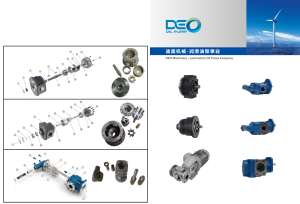
This guide explains how each specification is constructed, how the four interlock mathematically, and how DEO's DK630 electric lubrication pump (630 cc/rev, 950/1450 rpm, QT500 ductile iron), PST180 bidirectional internal gear pump (180 cc/rev, 1800 rpm max, −30°C to +100°C, GG250 or QT500 housing) and PSN100 trochoidal pump (QT500 ductile iron) are rated on paper — together with the DFLSL-10 self-circulating cooler and the DFLEX8 wind cooler on the cooling side. Every figure below is a published model rating, and every calculation is shown so it can be checked independently.
Problem Definition: When Spec Sheets Are Read as Labels Instead of Systems
The same mistake appears in most mis-specified lubrication circuits, and it appears in three forms.
- Displacement compared without speed. A buyer sees 630 cc/rev on the DK630 electric lubrication pump, 180 cc/rev on the PST180 bidirectional internal gear pump and 100 cc/rev on the PSN100 trochoidal pump, and concludes that the first pump delivers more oil. It only does so if the motor speed is the same. Displacement is a geometric property measured per revolution, not per minute.
- Temperature range read as an ambient rating. The −30°C to +100°C range published for the PST180 and PSN100 describes the pump's operating temperature envelope, not the weather the machine stands in. DEO's DK series documentation expresses the same idea from the fluid side, listing a fluid temperature range of −40°C to 100°C.
- KW/℃ read as total cooling power. A per-degree figure is not a capacity figure. The DFLSL-10 self-circulating cooler is published at 1.61/1.84 KW/℃, and the DFLEX8 wind cooler at comparative values of 1.15/0.91 KW/℃. Neither number can be compared with a heat load until it is multiplied by the temperature differential the installation actually produces.
Installation errors compound the same problem. A suction line that is not airtight reduces circulation flow and, on a self-circulating cooler, sharply reduces cooling capacity. Oil carrying metal chips or sand scratches gear surfaces and wears bushings rapidly. Dry running burns shaft bushings and gears within a short operating time. And the built-in relief valve is a transient pressure protection device, not a working bypass: continuous overflow operation leads to pump overheating and early wear.
Industry Background: Why These Numbers Now Carry More Weight
Lubrication is no longer treated as a maintenance afterthought, and the market data reflects it. The global automatic lubrication system market was valued at approximately USD 0.37 billion in 2024 (Market Research Future). More pointedly, improper lubrication is linked to more than 76% of industrial machinery failures, according to the Lubrication Systems Market Size Report 2035 — a correlation that explains why centralized lubrication is increasingly specified on new equipment rather than retrofitted after a failure. The same reporting estimates that centralized lubrication systems can reduce maintenance downtime by up to 52% in manufacturing facilities.
Supply and demand both concentrate in Asia. Asia-Pacific accounted for approximately 42% of total global lubrication system shipments in 2024, and China exported USD 14.3 billion in liquid pumps — a category that includes lubrication pumps — in the same year, equal to 18.5% of global exports (Observatory of Economic Complexity). Cooling hardware tracks the same curve: the global oil coolers market used in lubrication cooling systems was valued at USD 6.8 billion in 2025 (Dataintelo). The reference group against which technical specifications are usually benchmarked includes SKF Group, Lincoln Industrial, Graco Inc. and Bijur Delimon, per ISOHITECH industry analysis.
One standard runs through all of it. ISO 4406 is the primary international standard for quantifying particle contamination in hydraulic and lubrication fluids, using a three-part code such as 18/15/13. It converts “clean oil” from an instruction into a measurable target — which matters, because the cleanliness requirement attached to DEO's DK series states plainly that the oil must be free of metal chips, sand and other solid impurities.
The supplier behind the reference models in this guide is Deo Machinery Co., Ltd. (DEO), established in 2010 and specialising in industrial lube oil cooling systems, lubrication system oil coolers, hydraulic pumps, electric lubrication pumps, centralized lubrication system pumps and oil lubrication pump systems. Its manufacturing facility covers 10,000 square metres with approximately 80 employees and an annual production capacity of 30,000 units.
Detailed Solution: The Four Specification Families, Read Correctly
1. Displacement (cc/rev): Volume per Revolution, Not Flow
Displacement states how many cubic centimetres of oil the pump moves in one complete revolution. It is independent of time until it is paired with a speed. DEO's three reference pumps span a wide band: the PSN100 trochoidal pump at 100 cc/rev, the PST180 bidirectional internal gear pump at 180 cc/rev, and the DK630 electric lubrication pump at 630 cc/rev. A larger displacement reduces the speed required to reach a target flow, which in practice is the reason high-displacement pumps appear in high-flow lubrication circuits rather than because they are “stronger”.
2. Motor Speed (rpm): The Multiplier and the Ceiling
Speed is published in two different ways, and the difference matters. The DK630 is published with motor rotation speeds of 950 rpm or 1450 rpm — two build options from one displacement. The PST180 and PSN100 are published with a maximum speed of 1800 rpm, which is a ceiling rather than a setpoint. Speed also governs suction behaviour. DEO's DK series documentation advises reducing pump speed when oil viscosity exceeds 1000 cSt, because high-viscosity oil at excessive speed produces high suction resistance and cavitation.
3. Operating Temperature Range (°C): A Fluid Envelope, Not a Weather Rating
The PST180 and PSN100 are rated from −30°C to +100°C. The DK series is documented with a fluid temperature range from −40°C to 100°C across a kinematic viscosity band of 12 to 20000 cSt, and is described as operating in 24/6 mode — continuous operation 24 hours a day, six days a week. Temperature and viscosity must therefore be read together. A cold start with high-viscosity oil is the harder condition for suction, while sustained high oil temperature is the harder condition for the cooling side and for seal life.
4. Cooling Capacity (KW/℃): A Per-Degree Figure, Not a Total
KW/℃ states how much heat the unit removes for each degree of temperature difference between the oil and the cooling medium. Air-cooled units work against ambient air; water-cooled units work against the cooling water temperature. Total heat rejection is therefore the published figure multiplied by the achievable differential.
Worked illustration. If the DFLSL-10 self-circulating cooler is applied at its published 1.61 KW/℃ figure and the installation can hold a 20°C differential, the arithmetic is 1.61 × 20, giving roughly 32.2 kW of heat removal at that differential. This is arithmetic on published ratings, not a test result — actual performance depends on the circuit, the oil and the site.
DEO publishes two cooling-capacity figures for the DFLSL-10 (1.61/1.84 KW/℃) alongside two oil pump flow options (100–125 L/min or 150–200 L/min on VG46 oil), and two comparative values for the DFLEX8 wind cooler (1.15/0.91 KW/℃). Because the mapping of each figure to a specific duty point is not stated in the published data, the intended operating point should be confirmed with the supplier rather than assumed. That is a limitation of the published specification, and treating it as a limitation is what separates a technical selection from a guess.
Step-by-Step Breakdown: Matching cc/rev, rpm and KW/℃ to One Circuit
Step 1 — Establish the required oil flow at the lubrication points
Start from the consumers, not the pump. Total the oil volume that must reach bearings, gears, sliding rails and any hydraulic auxiliary loop per minute, then add allowance for line losses and for points that sit far from the supply. This figure, in litres per minute, is the only real input the rest of the calculation needs.
Step 2 — Convert flow into displacement × speed
The conversion is direct:
Q (L/min) = displacement (cc/rev) × speed (rpm) ÷ 1000
Applied to the published DEO ratings as theoretical displacement flow:
- DK630 at 950 rpm: 630 × 950 = 598,500 cc/min, or about 598.5 L/min
- DK630 at 1450 rpm: 630 × 1450 = 913,500 cc/min, or about 913.5 L/min
- PST180 at its 1800 rpm maximum: 180 × 1800 = 324,000 cc/min, or about 324 L/min
- PSN100 at its 1800 rpm maximum: 100 × 1800 = 180,000 cc/min, or about 180 L/min
These are theoretical figures derived from the two published ratings. Delivered flow is lower, and volumetric efficiency data is not part of the released specification set, so the calculated value is a selection input rather than a guaranteed output.
Step 3 — Check the speed ceiling against the real drive
The PST180 and PSN100 are both limited to a maximum of 1800 rpm. Where a pump is driven from an existing line shaft rather than a dedicated motor, the available input speed — not the rated displacement — usually sets the achievable flow, and a larger displacement may be the correct response instead of a higher speed.
Step 4 — Verify viscosity and temperature together
Match the actual oil grade and its cold-start and hot-running temperatures against the published envelope: 12 to 20000 cSt and −40°C to 100°C for the DK series, and −30°C to +100°C for the PST180 and PSN100. For oil above 1000 cSt, the DK series guidance is explicit: reduce pump speed to avoid excessive suction resistance and cavitation.
Step 5 — Size the cooling side from the heat load
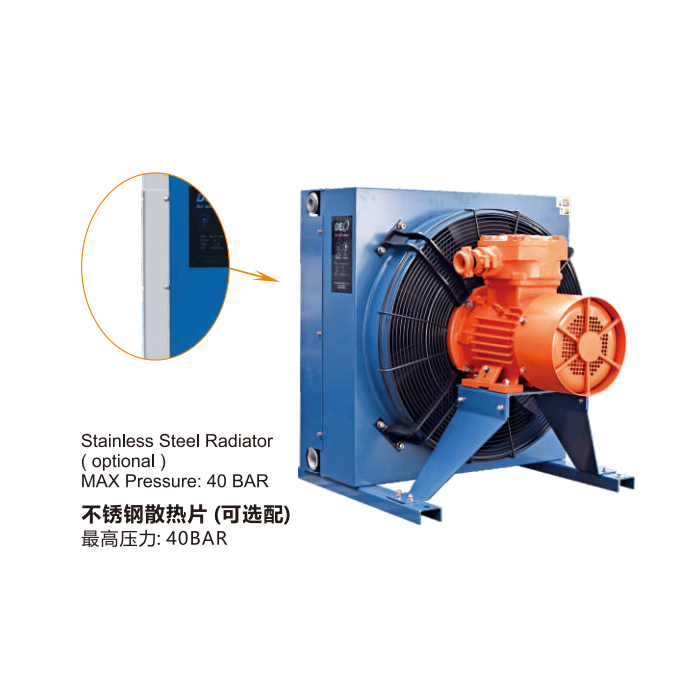
Sum the friction heat generated at the lubrication points and any churning losses in gearboxes or reducers, then divide by the temperature differential the installation can tolerate to obtain the required KW/℃ rating. At this point the choice is between an air-cooled self-circulating unit such as the DFLSL-10, an air-cooled wind cooler such as the DFLEX8 (630 mm fan, 3-phase 380V motor, copper radiator), and a water-cooled alternative such as the DWBW-408-T fin-type oil/water cooler — a shell-and-tube finned heat exchanger with a carbon steel shell, high-purity copper tubes and aluminium fins, rated to 16 bar on the oil side and 10 bar on the water side, with allowable cooling water temperature of 5–60°C, allowable oil medium temperature up to 120°C and applicable oil kinematic viscosity of 12–320 mm²/s. On the DFLSL-10, the cooler's own oil pump flow (100–125 L/min or 150–200 L/min on VG46) also has to be compatible with the circuit it serves.
Step 6 — Confirm the installation prerequisites
- The pump inlet pipeline must be airtight; an air-leaking suction line causes insufficient suction flow and cavitation.
- The inlet pipe diameter must not be smaller than the pump inlet port, to avoid flow restriction and pressure loss.
- The oil must be free of metal chips, sand and other solid impurities; particle contamination scratches gear surfaces and wears bushings rapidly.
- Dry running is prohibited — dry friction burns shaft bushings and gears in a short time.
- The marked rotation direction on the pump nameplate must be followed; reverse rotation invalidates sealing and causes leakage failure.
- For pump-plus-motor unit assemblies, the bell housing and motor shaft must be kept coaxial.
- Self-circulating cooler units should be mounted with shock-absorbing gaskets, with ventilation space reserved around the radiator and no blockage of air inlet or outlet; a filter is mandatory under heavy pollution conditions.
Step 7 — Confirm the protection logic
The DK series carries a built-in relief valve with a standard setting range of 5 to 25 bar, intended for transient pressure protection only; continuous overflow operation causes overheating and early wear. DEO's self-circulating air-cooled oil cooler documentation additionally describes an optional temperature bypass valve that opens between a 45°C and 55°C threshold to speed cold-start preheating, an optional pressure bypass valve for instantaneous flow and pressure spikes, and optional temperature or pressure switches for over-temperature and over-pressure alarm monitoring.
Specification Comparison: Pumps and Coolers Side by Side
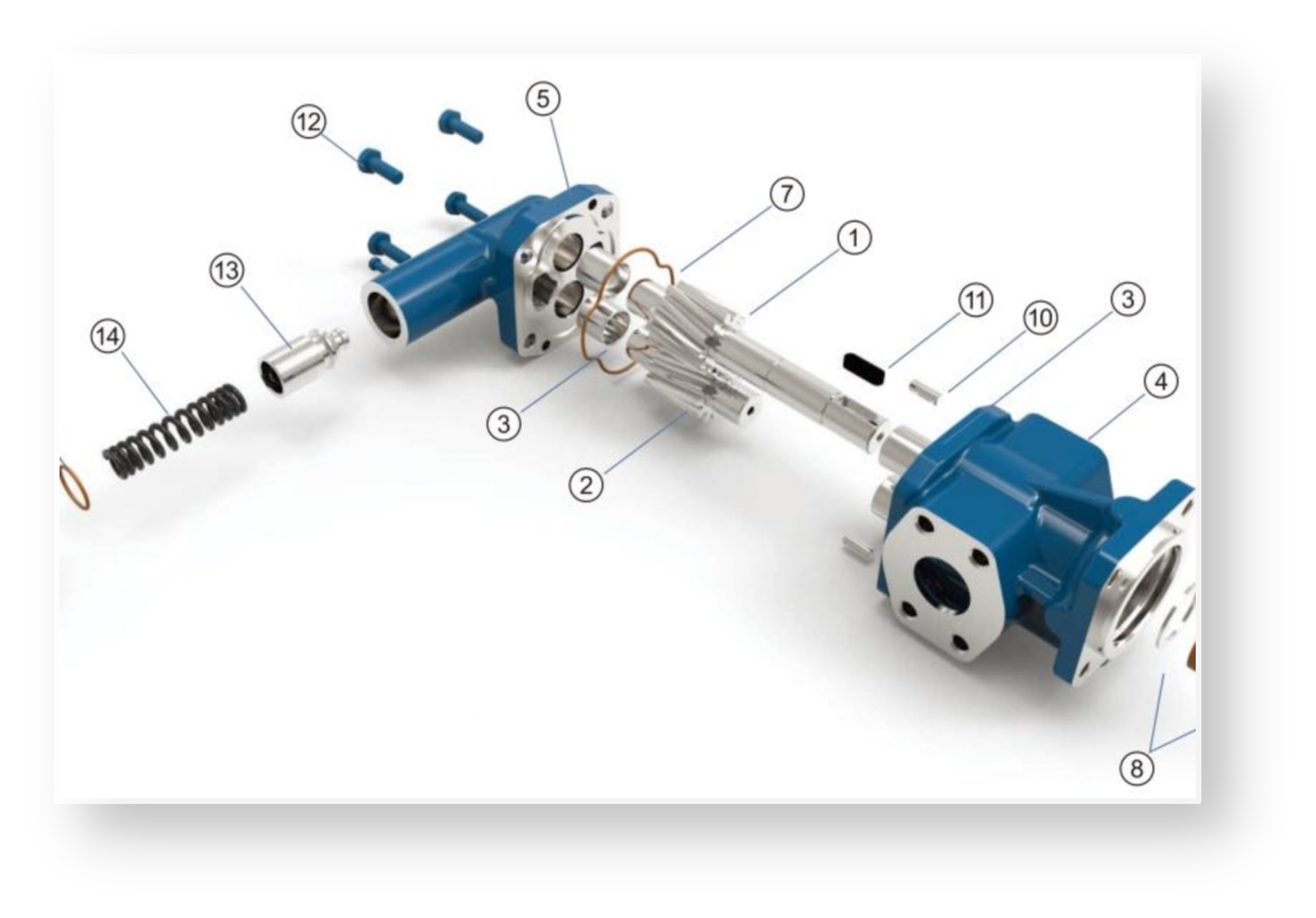
The three DEO pumps occupy different positions in the same circuit logic. The DK630 is an electric lubrication pump in the industrial lubrication pump category, applied to machinery and heavy industry including steel, construction and mining equipment. The PST180 is a bidirectional internal gear pump used in engine lubrication systems, hydraulic systems, hydraulic power units, construction machinery, forklifts and telehandlers, automation mechanical equipment and industrial cooling systems. The PSN100 is a trochoidal, bidirectional mechanical pump intended for lubricating systems, cooling systems and external drive independent conveying systems.
| Parameter | DK630 electric lubrication pump | PST180 bidirectional internal gear pump | PSN100 trochoidal pump |
|---|---|---|---|
| Displacement | 630 cc/rev | 180 cc/rev | 100 cc/rev |
| Speed | Motor rotation speed 950 rpm or 1450 rpm | Maximum 1800 rpm | Maximum 1800 rpm |
| Operating temperature range | Not stated in the released model rating; DK series documentation lists fluid temperature −40°C to 100°C and viscosity 12–20,000 cSt | −30°C to +100°C | −30°C to +100°C |
| Housing / body material | QT500 ductile iron | GG250 gray cast iron or QT500 ductile iron | QT500 ductile iron |
| Pump type | Electric lubrication pump, industrial lubrication pump category | Bidirectional internal gear pump | Trochoidal pump, bidirectional mechanical pump |
| Stated application scope | Machinery and heavy industry, including steel, construction machinery and mining equipment; industrial lubrication systems | Hydraulic systems, engine lubrication systems, construction machinery, forklifts and telehandlers, automation mechanical equipment, hydraulic power units, industrial cooling systems | Lubricating systems, cooling systems, external drive independent conveying systems |
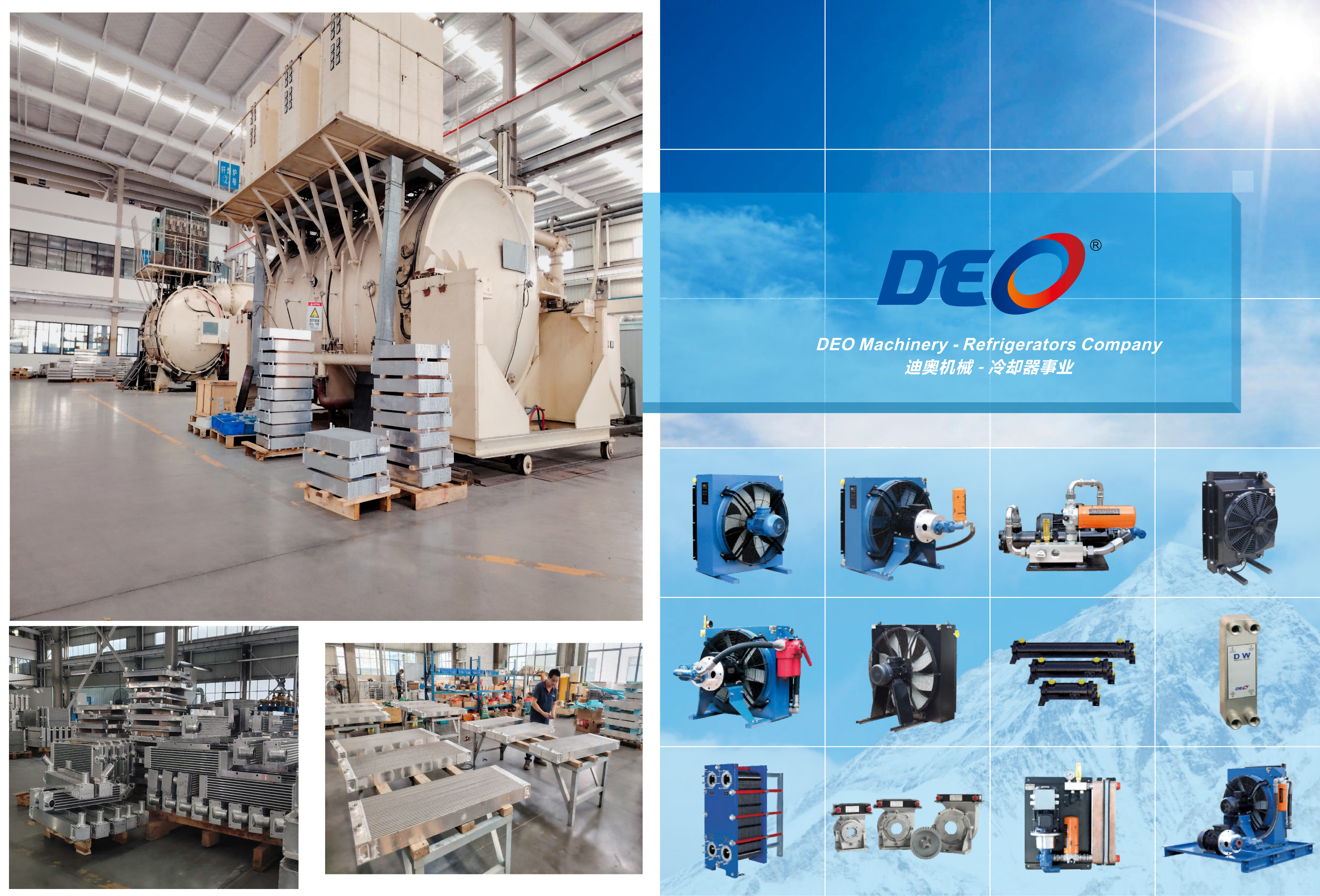
On the cooling side, the three DEO units differ less by “size” than by medium and duty. The DFLSL-10 is a self-circulating cooler with its own oil pump, the DFLEX8 is a wind cooler using a 630 mm fan with a 3-phase 380V motor, and the DWBW-408-T is an oil/water cooler for installations where cooling water is available.
| Parameter | DFLSL-10 self-circulating cooler | DFLEX8 wind cooler | DWBW-408-T fin-type oil/water cooler |
|---|---|---|---|
| Cooling capacity | 1.61 / 1.84 KW/℃ | 1.15 / 0.91 KW/℃, published as comparative cooling capacity | Not stated in the released rating set; heat exchange area 1.3 m² up to dozens of m² |
| Oil-side flow | Oil pump flow 100–125 L/min or 150–200 L/min on VG46 | Not stated in the released rating set | Not stated in the released rating set |
| Power / drive | Consumed power 5.5 / 7.5 KW | Fan diameter 630 mm; motor voltage 3-phase 380V | Not stated in the released rating set |
| Cooling medium | Air; radiator copper, stainless steel customizable | Air; radiator copper, stainless steel customizable | Water; allowable cooling water temperature 5–60°C |
| Pressure rating | Not stated in the released rating set | Not stated in the released rating set | Maximum working pressure 16 bar oil side, 10 bar water side |
| Stated application scope | Hydraulic and lubricating systems, extruding machinery, forging and stamping equipment, shearing machines, gearboxes, large bearings, nuclear power plants, large-scale reduction boxes, smelting equipment | Cooling and wind energy, nuclear power plants, gearboxes and reducers, lubricating systems, construction machinery, crude oil mining, coal mines, hydraulic systems | Heavy machinery and metallurgy, mining and construction machinery, wind power, marine and ship industry, hydraulic stations and machine tools |
Use Cases: Where These Specifications Meet Real Equipment
Mining equipment. The DK630 electric lubrication pump is classified for lubrication pump service in mining equipment, and the DFLEX8 wind cooler is intended for coal mines and crude oil mining alongside hydraulic and lubrication systems. In these applications the installation prerequisites matter more than the catalogue numbers: dust ingress, contaminated oil and non-airtight suction lines are the normal failure path, which is why the cleanliness requirement and the mandatory filter for heavy pollution conditions belong in the specification, not in the maintenance manual.
Construction machinery. The DK630 is intended for construction machinery, the PST180 for construction machinery and hydraulic power units, and the DFLEX8 for construction machinery as well as hydraulic systems. Mobile duty cycles push the temperature and suction checks to the front of the selection, since ambient extremes and high-viscosity cold starts are routine.
Steel and heavy industry. The DK630 is specified for the steel industry, while the DFLSL-10 self-circulating cooler lists smelting equipment, large-scale reduction boxes and large bearings among its intended applications, and the DWBW-408-T covers rolling mill lubrication stations and high-viscosity lubricating oil cooling under continuous heavy load. This is where the per-degree KW/℃ reading earns its keep: continuous heat input with a stable oil temperature target is exactly the condition that punishes a cooler sized on a single headline number.
Wind energy. The DFLEX8 wind cooler is intended for wind energy and lubrication system cooling. DEO also documents a DKF variant of the DK series with enhanced anti-shock and anti-vibration performance for wind turbine variable-speed and alternating-load conditions, and the DWBW-408-T supports a seawater-cooling customised version for coastal wind farms.
Machine tools and hydraulic stations. The PST180 covers hydraulic power units, forklifts, telehandlers and automation mechanical equipment, while the DWBW-408-T addresses centralized hydraulic oil cooling for CNC machine tools, injection moulding machines and die-casting equipment. The PSN100 covers external drive independent conveying systems and cooling systems where the pump must run independently of the host machine's own circuit.
Frequently Asked Questions
What should be verified in an industrial lubrication pump specification before an order is placed?
Four things are worth verifying against the published data. First, housing material grade: the DK630 and PSN100 are QT500 ductile iron, while the PST180 housing is GG250 gray cast iron or QT500 ductile iron. Second, oil cleanliness, because the DK series requirement is that the oil be free of metal chips, sand and other solid impurities — ISO 4406, the international standard for quantifying particle contamination with a three-part code such as 18/15/13, is the usual way to express that as a measurable target. Third, protection setting: the DK series built-in relief valve has a standard setting range of 5 to 25 bar and is intended for transient pressure protection only. Fourth, pressure ratings on the cooling side, such as the 16 bar oil-side and 10 bar water-side maximum working pressures published for the DWBW-408-T fin-type oil/water cooler.
How do cc/rev and rpm combine into an actual flow rate in litres per minute?
Flow is displacement multiplied by speed, divided by 1000: Q (L/min) = cc/rev × rpm ÷ 1000. Using published DEO ratings, the DK630 electric lubrication pump at 630 cc/rev and 950 rpm gives 630 × 950 = 598,500 cc/min, or about 598.5 L/min of theoretical displacement flow; the same pump at 1450 rpm gives about 913.5 L/min. The PST180 at 180 cc/rev and its 1800 rpm maximum gives about 324 L/min, and the PSN100 at 100 cc/rev and 1800 rpm gives about 180 L/min. These are theoretical values calculated from two published ratings; delivered flow is lower, and volumetric efficiency is not part of the released specification set.
Which DEO pump suits a circuit that needs bidirectional operation or feeds a cooling loop?
Bidirectional operation points to two models. The PST180 bidirectional internal gear pump is rated at 180 cc/rev, a maximum of 1800 rpm and −30°C to +100°C, with a GG250 gray cast iron or QT500 ductile iron housing, and is used in engine lubrication systems, hydraulic systems, hydraulic power units, construction machinery, forklifts and telehandlers, automation mechanical equipment and industrial cooling systems. The PSN100 trochoidal bidirectional mechanical pump is rated at 100 cc/rev, a maximum of 1800 rpm and −30°C to +100°C in QT500 ductile iron, and is intended for lubricating systems, cooling systems and external drive independent conveying systems. Where the circuit is a lubrication supply rather than a reversing duty, the DK630 electric lubrication pump at 630 cc/rev with 950 rpm or 1450 rpm motor speeds is the pump classed for industrial lubrication systems in machinery, steel, construction and mining.
What drives the running cost of a lubrication pump and cooler package?
The most directly readable cost driver in the published data is consumed power. The DFLSL-10 self-circulating cooler is published with consumed power figures of 5.5 KW and 7.5 KW, and the DFLEX8 wind cooler uses a 3-phase 380V motor with a 630 mm fan. Cooling capacity per degree determines how much heat removal each unit delivers per degree of temperature difference — 1.61/1.84 KW/℃ for the DFLSL-10 and 1.15/0.91 KW/℃ comparative for the DFLEX8 — so selecting on real heat load and real differential avoids paying for capacity the installation cannot use. On the pump side, the specification decisions that shape what is built are displacement, motor speed option, and housing material grade.
Can the published specifications be validated on a sample before a bulk order?
Yes, and it is the practical answer to the gap between theoretical and delivered flow. A validation run is most useful when it checks four things: delivered flow against the calculated displacement × speed figure; oil temperature stabilisation under the intended duty cycle; whether the inlet piping is genuinely airtight, since an air-leaking suction line reduces circulation flow and sharply reduces cooling capacity; and oil cleanliness, since the pump medium must be free of metal chips, sand and other solid impurities. To arrange a sample, request specifications or discuss a replacement for an existing pump, contact Deo Machinery Co., Ltd. at deolun@cndeo.cn or +86 18957417960. The full product catalogue is available as a downloadable brochure.
Conclusion: Three Numbers, One Selection Logic
Reading cc/rev, rpm and KW/℃ correctly is not an academic exercise. Displacement multiplied by speed produces the flow the circuit will receive; the temperature and viscosity envelope determines whether that flow arrives without cavitation; and the per-degree cooling figure determines whether the oil stays inside its safe band over a 24/6 duty cycle. Each figure is only meaningful when read against the other three — which is also why spec sheets from different industrial lubrication pump manufacturers should be compared in the same format, with derived values recalculated rather than taken on trust.
DEO publishes the underlying ratings for the DK630 electric lubrication pump, the PST180 bidirectional internal gear pump, the PSN100 trochoidal pump, the DFLSL-10 self-circulating cooler, the DFLEX8 wind cooler and the DWBW-408-T fin-type oil/water cooler, so that flow, temperature and cooling capacity can be checked before a circuit is built rather than after it runs hot.
Next step. Send us your required flow, oil grade and target oil temperature, and we will match them against the DK630, PST180, PSN100, DFLSL-10, DFLEX8 or DWBW-408-T ratings and confirm the duty point in writing.
Email: deolun@cndeo.cn | Tel: +86 18957417960 | Website: www.cndeo.com
Download the full DEO product brochure: DEO catalogue (PDF)
Have Questions or Need More Details?
Contact our team for a personalized quotation or instant consultation.
Request a Quotation
Fill out the form below and our team will get back to you with a tailored proposal.
WhatsApp Direct Chat
Prefer to chat in real-time? Message us on WhatsApp for instant assistance & quick answers.
- Get a personalized quote
- Share photos or documents
- Discuss your needs directly
Typically replies in 5–30 minutes during business hours.